A Reflection for Easter Sunday
Readings: Acts 10: 34a, 37-43 (RM) or 34-43, or alt. Isaiah 65: 17-25 (RCL); Psalm 118; Colossians 3: 1-4 (RM) or 1 Corinthians 15: 19-26 or Acts 10: 34-43 (RCL); John 20: 1-9 (RM in U.S.) or 1-18 (RM in Canada and RCL), or Luke 24: 13-35 (RM) or Luke 24: 1-12 (RCL)
My mother used to claim that early on Easter Sunday morning, the light shone through the stained-glass window in the sanctuary with a unique glow.
We didn’t say much because, after all, Easter can fall anytime between March 22 and April 25, with Daylight Savings Time shifting the clock, so the precise angle of sunlight at 6:30 am on Easter Sunday every year would have to be different. Mom was an artist, well aware of how light falls. But she wasn’t talking physics. She was expressing a lived theology.
The window had been custom-made for this church. My grandfather built the brick church in 1916, and the window design was taken from a book of Bible stories that belonged to my grandmother, whom he had married the year before. My mom used to read me a bedtime story from this book when I was little – the same book, same image, both in church and at home cuddled in bed.
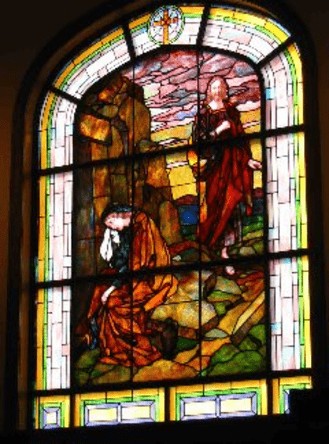
For me this image expresses the powerful moment of tension just before Jesus calls Mary’s name. She whirls around and sees he is alive. She tries to touch him, but he says No, and gives her a commission to announce his resurrection to his faraway disciples. In this way, I grew up with a front-and-centre image of a woman’s call to ministry directly from Christ. Even though, just below this symmetrical and vibrantly coloured work of art, only males stood at the altar or served as acolytes, Jesus was calling a woman by name. In the visual image there is no mistaking, no dissembling, no “Jesus called only men to be apostles.” Thus the early church called Mary of Magdala, “the apostle to the apostles.”
Now, depending on your denominational affiliation, you could be wondering why you might not have heard this compelling story as the Easter Gospel.
If you are a Canadian Roman Catholic, you probably did. The Easter Gospel is either the short version, John 20 verses 1-9, or the longer version up to verse 18. Luke’s account of the Emmaus journey comes up as an alternative later in the day.
If you affiliate with the Anglican Church of Canada, you probably heard it read at the Easter Eucharist.
If you belong to a Protestant denomination that uses the Revised Common Lectionary, you either heard this whole story from John, or Luke’s resurrection account.
But if you are a Roman Catholic in the USA, you’re out of luck. You only hear the beginning episode of John 20, or alternately Luke’s Emmaus account. Mary of Magdala’s call and commission is only read as the Gospel for Mass on the Tuesday, yes Tuesday, of Easter week. It was as if they couldn’t bury it much deeper and still keep it somewhere in the Easter season.
But let’s go back to lived theology. In her own way Mom had it right – the lived theology of the resurrection is embedded in both light and time. Both mark the start of the story:
“Early on the first day of the week, while it was still dark…”
Mary, then Peter and the other disciple, pivoted sharply from not knowing, to seeing the emptiness of the tomb, to the unthinkable – that Jesus had not merely disappeared, but was alive. They moved from darkness, to the dawn of stunned surprise, to the full light of belief in an event that defies credulity. Mary for her part shifted from confused speculation about what had happened, to a real-time dialogue with her beloved Teacher and friend, who gave her direct instructions.
And it happened “on the first day of the week,” the dawn of a new week, and of a new era. From then on, Christians would gather to listen and break bread “on the first day of the week,” in his living memory.
© Susan K. Roll
Lightly edited from the Reflection of April 17, 2022
Susan Roll retired from the Faculty of Theology at Saint Paul University, Ottawa, in 2018, where she served as Director of the Sophia Research Centre. Her research and publications are centred in the fields of liturgy, sacraments, and feminist theology. She holds a Ph.D. from the Catholic University of Leuven (Louvain), Belgium, and has been involved with international academic societies in liturgy and theology, as well as university chaplaincy, Indigenous ministry and church reform projects.

Thank you,Susan, for pointing out the light and time of the lived theology of the Eucharist, and the call and commission of Mary Magdala. Again, I learn from your scriptural research.