Reflection for the Second Sunday of Easter C
Readings: Acts 5: 12-16 (RM) or 27-32 (RCL); Psalm 118; Revelation 1: 9-11a, 12-13, 17-19 (RM) or 4-8 (RCL); John 20: 19-31.
There’s much to be said for well-founded doubt. Doubt is not necessarily an indication of disloyalty, or lack of intelligence, or disobedience, or waffling. It simply means your brain is working, the way God meant it to.
In fact reasonable doubt can be the first step toward a historic breakthrough that moves humanity farther along in its knowledge and development. Imagine for a moment that Galileo had not doubted the harshly-enforced “official truth” that the sun revolves around the earth. Then imagine that he did not maintain his belief in the accuracy of his own observations. Granted, he was silenced by the threat of torture. But as the story goes, on his deathbed he mumbled,
“Eppure, si muove.” (“Nonetheless, it –the earth–moves.”)
What if the leaders of the 19th-century abolition movement – William Wilberforce in England, Frederick Douglass, Harriet Tubman and many others in the U.S. – had not found the courage to act on their well-founded doubt that slavery was the will of God? What if they had not defied the conventional use of proof-texts extracted from Scripture that attempted to justify ownership of human persons?
What would the Christian church, in all denominations, look like today if Martin Luther had not acted prophetically on his doubts that God intended forgiveness from sins and admission to heaven to be objects of commerce? Bought and sold?*
Perhaps the first step toward engagement in the work of faith-based social justice is simply — doubt.
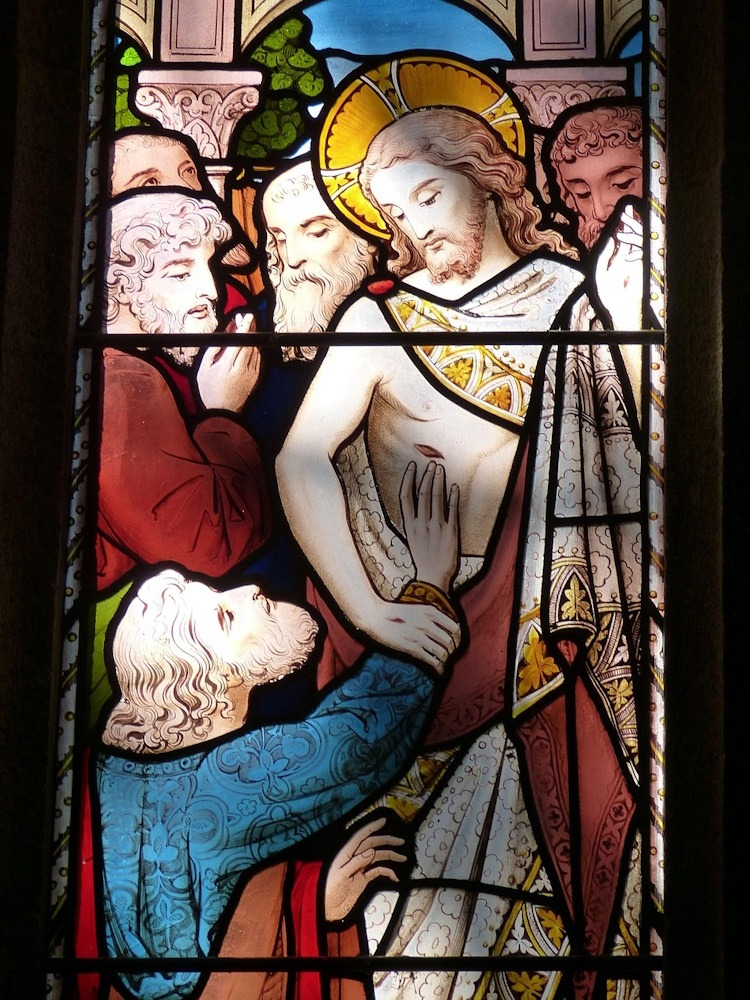
If we give in to the temptation to see the disciple Thomas as the guy who got it wrong and had to walk it back, we might easily identify with him on a human level – I mean, who doesn’t get it wrong from time to time in their lives? But we would be missing the fact that this story in the Gospel of John, the last of the four canonical Gospels, has been carefully constructed to present later theological understandings of who Christ was, and to cope with the situation of the Christian communities several generations after the earthly lifetime of the historical Jesus.
By the years 90-100 of the Common Era, how many people were still alive who had actually known Jesus of Nazareth? In order to believe that he was the Christ, the Anointed One of God, and that he had risen from the dead after a gruesome execution, one would need to believe the witness accounts that had survived. And seriously, many of these were easy to doubt. Feed five thousand in the middle of nowhere? Heal the sick with a word, or a touch? Where do you draw the line between credulity and inspired faith? How do you wrap your mind around a remarkable event described to you that you did not experience personally?
And this is precisely what happened to Thomas. The writers of John set up two parallel appearance stories – in each, he appears on the first day of the week, in a closed room, and wishes them peace. But the character of Thomas is absent from the first and present for the second. Thomas’ absence reflects the distance between Christians at the turn of the first century, and the original generation of believers.
Thomas had announced that he would need physical proof that Christ was alive, and Jesus offered him exactly what he had demanded. Still, nothing in the story suggests that Thomas actually touched the wounds. His breathless exclamation, “My Lord and my God,” marks a theological breakthrough. There is not any doubt. Christ is God. That was John’s point from the beginning of this Gospel:
“In the beginning was the Word, and the Word was with God, and the Word was God.”
Thomas isn’t reaching this realization on his own, but within the context of a faith community, just as later generations of Christians live their faith commitment among and within a supportive community of the baptized. And here the text ends – verses 30-31 really are the original ending—and life in Christ begins, not once in a static way but dynamically, beyond time, and story, and even doubt.
© Susan K. Roll
*For these examples I am indebted to the late Rachel Held Evans, in Faith Unraveled.
This is a lightly revised version of the Reflection for April 24, 2022.
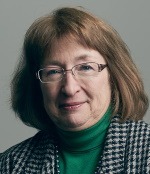
Susan Roll retired from the Faculty of Theology at Saint Paul University, Ottawa, in 2018, where she served as Director of the Sophia Research Centre. Her research and publications are centred in the fields of liturgy, sacraments, and feminist theology. She holds a Ph.D. from the Catholic University of Leuven (Louvain), Belgium, and has been involved with international academic societies in liturgy and theology, as well as university chaplaincy, Indigenous ministry and church reform projects.