I am sure I am not alone in being horrified and appalled by what is happening in Gaza, and sadly, increasingly in the West Bank. Hamas’ violent attack on Israeli settlers in October 2023 required a response for Israel, but surely not on the scale we now see.
Every so often I come across people, fortunately not too many, who are supportive of Israel’s horrific response. For these people, all Palestinians, whom they usually wrongly refer to as Arabs, are terrorists and getting what terrorists deserve.
Etymologically, the name “Palestine” can be traced back to “Philistia.” The Philistines were a tribal people living in the land of Canaan, who often warred against the Hebrews when they tried to take over the “promised land.” Remember David’s victory over Goliath, the Philistine giant. That time, around 3000 years ago, the Hebrew people emerge as the “underdogs.”
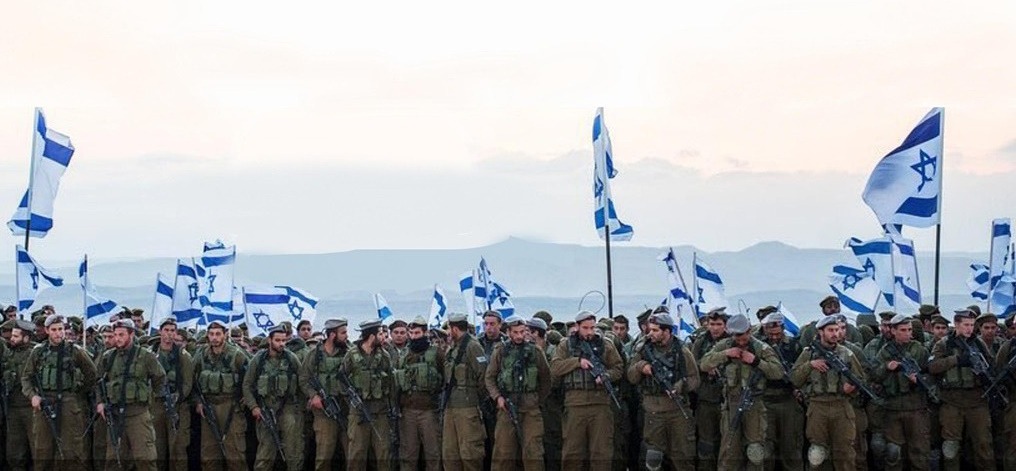
Israeli Army
How that has changed. Today Israel is one of the most powerfully armed, probably nuclear- armed, countries in the world, a country with the most sophisticated surveillance equipment there is. Furthermore, it is supported militarily and financially by the most powerful country in the world. Even more concerning is that both now Israel and the USA seem hell-bent on ridding Gaza of Palestinians.
I am a keen reader and enjoy reading both history and thrillers and spy books. I am becoming increasingly aware how fiction influences how we think about contemporary situations. For example, one American author, a convert from Catholicism to Judaism, writes extensively about plucky Israel seemingly saving all and sundry from Arab terrorism. If we know author, and well we may, as his books are there in every international airport, the goodies always win, and unless we are careful, we can be persuaded to blame Arab terrorism for much that is wrong in our world today. There is plenty on social media to reinforce such prejudiced positions.
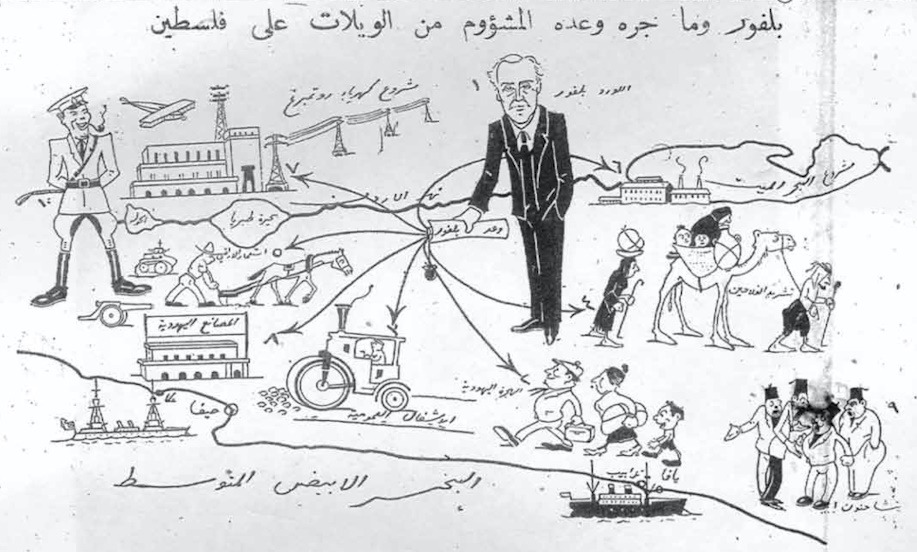
Falastin newspaper edition in 1932 featuring a caricature lamenting Balfour declaration's impacts on Palestine, showing Jewish immigration, and dispossession of Arab peasants (Courtesy: Wikipedia)
I think reading history saves me. When I read about the British government’s 1917 Balfour Declaration, when I read about the return of Jewish survivors of the Holocaust to Israel, and the subsequent war in 1947-48 that saw thousands of Palestinians exiled from their homes to Gaza, I know there are other explanations for today’s genocidal warfare in Gaza. It is not primarily about Arab terrorism. It has its origins in the cruel persecutions suffered by Jews at the hands of Europe’s Christians for centuries. The Holocaust was not an isolated incident, but it was certainly the worst instance of genocidal persecution. What could guilty Europe do after the conclusion of World War II? Arrange for Jews to return to the Promised Land. The problem was Palestinians, Christian and Muslim, were living there and had been living there for centuries.
I love reading thrillers and spy books, but I know I need to read history as well to ensure that I don’t fall into the trap of too readily identifying the “goodies” and “baddies” in very un-nuanced ways.
Susan Smith RNDM is a lecturer emerita in The University of Auckland’s Department of Theology. Her PhD was on developments in Catholic missiology after Vatican II. After her retirement from The University of Auckland, Susan also provided NT modules for the University of Newcastle, Australia, and a Women in Leadership module for Duquesne University. Susan lives with another member of her congregation in Whangarei, New Zealand, where both are committed to exploring experientially what it means to live in an eco-community. Both are involved in neighborhood environment organizations. They are particularly interested in what might shape eco-spiritualities in New Zealand.
Thank you Susan for this post, clearly illustrating your point that we need to read history to avoid ‘the trap of too readily identifying the “goodies” and “baddies” in very un-nuanced ways.’
Both the Israeli government and Hamas want us to do just that. And so every night on the evening news I watch genocide in Gaza on live TV. I feel the powerlessness and anger of that watching, and wonder how the people of Gaza can live with any sliver of hope in the midst of such destruction – everything around them in rubble, not a tree or bush or flower to be seen, always hungry, and running for their lives.




Thank you Susan for this post, clearly illustrating your point that we need to read history to avoid ‘the trap of too readily identifying the “goodies” and “baddies” in very un-nuanced ways.’
Both the Israeli government and Hamas want us to do just that. And so every night on the evening news I watch genocide in Gaza on live TV. I feel the powerlessness and anger of that watching, and wonder how the people of Gaza can live with any sliver of hope in the midst of such destruction – everything around them in rubble, not a tree or bush or flower to be seen, always hungry, and running for their lives.
I pray for the people of Gaza, and for us all.