
When you’re an invited dinner guest, or ordering from the menu at a restaurant, probably the last thing on your mind is whether the food is safe to eat. We tend to assume the food is fine, unless something else triggers your suspicions – perhaps the environment looks unclean, or the food doesn’t smell or taste quite right.
Or maybe the circumstances are just questionable enough to suggest caution is in order. I remember, many years ago, traveling on a train in Italy by myself. Several of us in a compartment struck up a conversation with a fellow passenger in the carriage. He got up and a few minutes later came back from the bistro car with two cups of espresso, one for him and one for me. I didn’t drink it. The coffee was probably OK, but he was a man traveling alone, I was a young woman alone in a foreign country. A quick check of my instincts told me I’d better not.
In our brief but somewhat obscure first reading from Genesis (for those who celebrate this Sunday as the Feast of the Body and Blood of Christ), a foreign king comes out to Abram and offers bread and wine. An apparent gesture of hospitality. But there are many layers to this story, more than you would suspect by its placement, along with Psalm 110, preceding today’s two New Testament accounts that serve to anchor in ancient tradition the Christian practice of gathering to break bread in memory of Jesus. Those readings are Paul’s narrative account in I Corinthians, and a multiplication-of-the-bread miracle story in Luke.
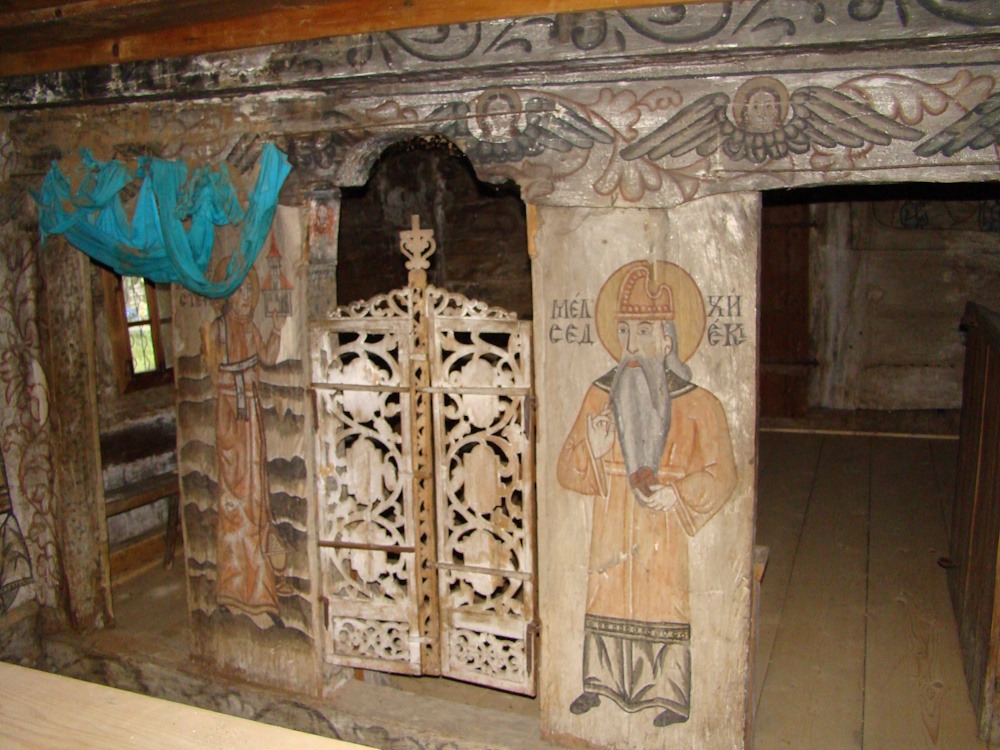
Melchizedek, whose name meant “righteous king,” governed the Jebusite city of Salem, on the site of the later Hebrew city of Jerusalem. King Melchizedek was a priest of a different god – not the saviour God of Israel, but a God identified as the creator of heaven and earth. This God, apparently, did not demand sacrifice to placate wrath and effect forgiveness, nor was this a mere tribal God, but instead a cosmic God. Melchizedek’s bread and wine was a sort of thanksgiving offering, possibly to thank his people’s God for Abram’s victory over their common foes.
Notice that Melchizedek does not bless the bread and wine. He blesses Abram. And Abram presents him with a thank offering in return, a tenth of what was probably plunder obtained after the conflict. Sharing food was an act of generosity that bonded the giver and the receiver.

Here’s another food story – and another train story. It did not happen in reality. This was a dream. Dreams have their own, often bizarre ways of expressing literally a metaphor that reflects some event, or some fear, in one’s waking life. Once in a dream, I was on a moving train. I was sitting on the floor of an empty carriage by the door. It was a prison train. I was a prisoner. There were guards. I was holding two take-out packages of food I had been given for the journey. But the food had been poisoned. I knew that from reading the ingredient labels. The guards were out of sight for a moment. I was able to pry open the train doors and throw the poisoned food out.
Let’s build on this, from two approaches:
- Is there anything in our own lives, or in the lives of our friends or family, or in the life of our society or our country, that represents poisoned food?
- Are there tempting delicacies at hand that we dare not even taste?
- Are there forms of “food” in our lives, or in our world, that must be thrown out the door and never touched?
- Who is offering us “food,” and can they be trusted?
And:
- Is there food that we share with another as a thanksgiving offering?
- Is there food of joy, food that marks a celebration, delightful rare food that nourishes us?
- And who else needs this nourishing food?
- Do we have enough to share?
There’s practically always enough to share in some way – that’s one takeaway we can glean from the Gospel, whether you prefer the multiplication-miracle interpretation or the idea that maybe everyone just pulled out the food they’d brought along for themselves, and shared it all. Whatever happened, there was plenty left over.
Twelve wicker baskets left over. Of really, really good food.
© Susan K. Roll
*Lightly edited from the Reflection of June 19, 2022.
Photo Credits:
Painting of Melchizedek by Țetcu Mircea Rareș, CC BY 2.5, https://commons.wikimedia.org/w/index.php?curid=6948424

Susan Roll retired from the Faculty of Theology at Saint Paul University, Ottawa, in 2018, where she served as Director of the Sophia Research Centre. Her research and publications are centred in the fields of liturgy, sacraments, and feminist theology. She holds a Ph.D. from the Catholic University of Leuven (Louvain), Belgium, and has been involved with international academic societies in liturgy and theology, as well as university chaplaincy, Indigenous ministry and church reform projects.