
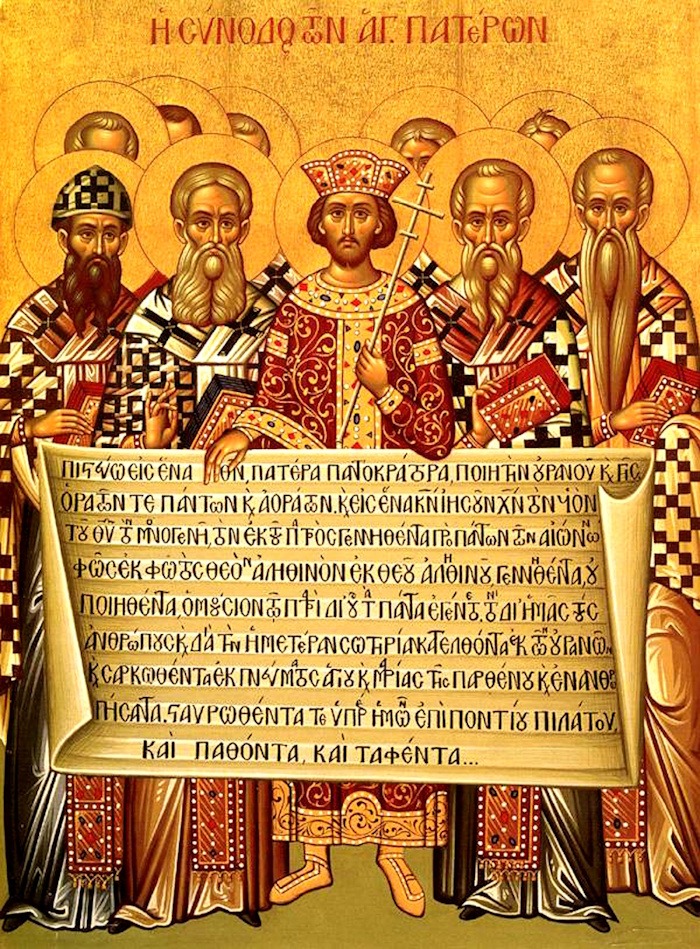
We have no record of Jesus setting dogmatic criteria or orthodoxy tests for those who wanted to follow his way. He didn’t demand belief in the real presence, the virgin birth, or apostolic succession. He didn’t even demand that we recite a creed saying that the Holy Spirit “proceeds from the Father and the Son,” a point that split Christianity sharply into East and West, mutually opposed, for hundreds of years. Now in 2025, the 1700th anniversary of the Nicene Creed, Christian denominations are increasingly dropping the “and the Son” part from the Nicene Creed. Church officials and theologians are rejoicing.
Not a point for Jesus. For him and his followers the stakes were much higher.
Look at what Jesus is shown to be saying in this week’s Gospel: Whoever comes to me and does not hate their father or mother is not worthy to be my disciple? Whoever does not carry a cross is not worthy of me? None of you can become my disciple if you do not give up all your possessions?! It’s quite amazing that the crowds did not disperse then and there, much as the crowd that had gathered to stone to death the woman trapped in adultery slinked away at Jesus’ words.
Oh, wait. Yes they did abandon Jesus. But much later — not before he had made his entry into Jerusalem, welcomed by a cheering crowd, who a few days later turned on him shouting “Crucify him!”
There’s a certain continuity between Luke’s account in last week’s Gospel and this, but also a few easily-misunderstood aspects of what Jesus is saying. As always, we need to prod ourselves to remember that Luke was writing several generations after the lifetime of the historical Jesus, and what he writes is coloured by the often dangerous situation of his own Christian community.
First, it sounds as if Jesus is addressing the same audience as in last week’s Gospel: elite males who carry immense family responsibility in their culture and who have much to lose financially, and in terms of property and prestige, if they even started to follow Jesus’ demands. You can tell who’s addressed by the fact that his list of “whom to hate” includes wife but not husband.
Another point of course is the startlingly harsh word “hate.” This does not sound like the Jesus who called on his followers to love their neighbour. In fact he commands them to love both God and neighbour. This was a language glitch translated literally into English without the cultural nuancing. While we today associate “hate” with a vicious, violent emotion, Scripture scholars generally believe that this meant simply “rejection” at worst, or “loving less than” at best. In other words, it’s a matter of choosing one’s priorities, and electing to commit oneself to a radical, risky way of life, rather than staying comfortably at home. Scripture scholar Dianne Bergant calls the word translated as “hate” a “Semitic idiom that refers to first loyalty, which implies that in choosing one thing one thereby excludes everything else.”
Point is, you can’t have it both ways. This can be tough for those of us who live in comfortable circumstances today, because we’re accustomed to having a range of choices. “Netflix or Paramount+? Pizza or lasagna? I want both!”
We’ve looped back to that familiar expression, the cost of discipleship. The challenges Jesus put forth, to love as God loves, with the same freedom, mercy and generosity, with a wholehearted commitment to live this way, is naturally going to put Christians at odds with their prevailing culture, to say nothing of many of their family and friends. Luke’s first-century Christian community was just finding that out. Their faith commitment did not merely set up temporary inconveniences or passing family altercations, it altered their lives. It could cost them their lives.
Today Christians are highly unlikely to be literally carrying a cross, or to be burnt at the stake (a great relief for those who work for reform, or speak truth to power.) Bergant suggests that choosing the cross today means to
“travel the high road: to forgive offenses committed against us; to live simply so others can simply live; to take responsibility for the moral character of society.”
There. That sounds more familiar. But not necessarily easier.
© Susan K. Roll
*Revised from the Reflection of September 4, 2022.

Susan Roll retired from the Faculty of Theology at Saint Paul University, Ottawa, in 2018, where she served as Director of the Sophia Research Centre. Her research and publications are centred in the fields of liturgy, sacraments, and feminist theology. She holds a Ph.D. from the Catholic University of Leuven (Louvain), Belgium, and has been involved with international academic societies in liturgy and theology, as well as university chaplaincy, Indigenous ministry and church reform projects.