
Two weeks ago I opened an Email from an old friend of mine, and my jaw just dropped. She sent the most amazing photo of herself.
My friend has been a leader in the movement for the ordination of women in the Roman Catholic church for decades. Every time there was an ordination of (male) priests at her city’s cathedral, she would be standing outside the entrance door with a placard. The archbishop knew her. She was involved with a training program for women toward the diaconate, and was a regular and vocal participant in organizations involved with the movement.
Two weeks ago she took part in a pilgrimage to Rome organized for mobility-impaired persons. And in the photo she was right there at the Vatican, seated in a wheelchair, with Pope Leo bending over before her for a conversation – and she was making a case for the admission of women to all ministries in the RC church!
Not to draw too tight an analogy with our Gospel reading today, it was a wonderful example of a woman’s persistence paying off.

Our Gospel for this Sunday is a parable, a story told to illustrate a point. But what point exactly? There are several different ways to parse this, not all of them consistent with Luke’s “pray always and do not lose heart.”
The official translations are much too cowardly. Here we have a spunky widow threatening to give the corrupt judge a black eye. Yes, that’s what the Greek text says, although what we hear and read will be, “wear me out,” “do me harm,” “cause me trouble,” “keeps bothering me,” or some such. Too namby-pamby.
Apparently she was alone in life. The custom in that time and culture made it normal that a widow, if she had no son or close male relative to regulate her affairs, would need a male official to do so. Was her legal custodian embezzling money, or stealing the property of her late husband? It wasn’t unheard-of, in fact Jesus accuses the scribes and Pharisees of exploiting widows just this way.
This woman was not to be messed with. She shames the judge into taking action just to get rid of her. Her persistent pleading would have attracted attention among the townspeople, and the judge risked losing face (also a big deal in this culture) as well as honour and prestige, unless he ruled in her favour. Usually we would think of a solitary widow in a patriarchal culture as highly vulnerable, but here she exploits the normally highly respected judge’s own vulnerability, and in public. She had law and common-sense justice on her side, and she wasn’t afraid to use it.
The corrupt judge is not an image of God, that’s obvious. Threatening God gets us nowhere.
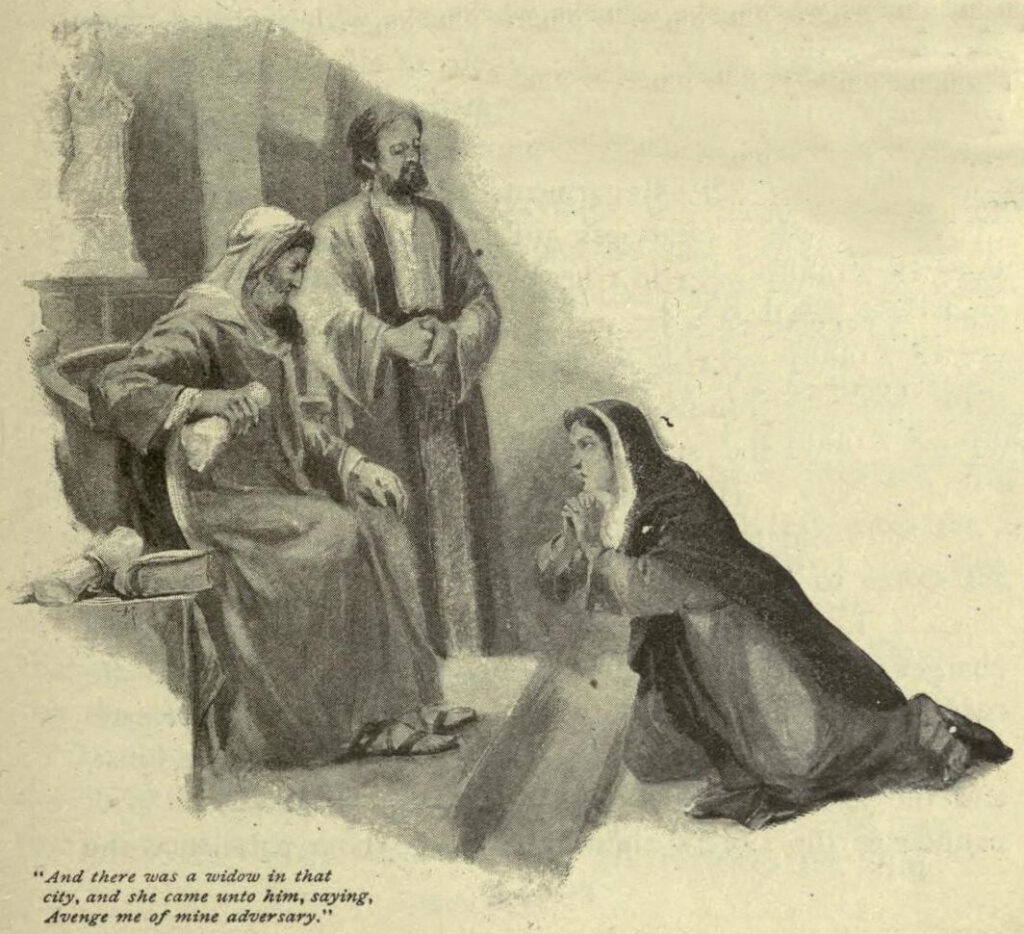
There’s a sexist way to interpret her actions, as that of a bothersome nag harassing this dignitary. But the salient point is perseverance. As Barbara Reid and Shelly Matthews point out in the Wisdom Commentary on Luke,
“…justice is achieved with persistence. Rarely is a single effort successful in turning around an unjust situation. Sustained efforts are especially needed when it comes to dismantling systems that maintain injustice. The widow embodies the endurance also seen in contemporary movements for justice led by contemporary women, such as the Madres de la Plaza de Mayo, Women in Black, and Black Lives Matter.”
And we might not see the results, not right away, and maybe not in our lifetime. The cryptic final line of this reading — when the Human One comes, will there be any faith to be found on earth? – points us in the direction of an indefinite future. A future not under our control. The actions may be ours, but the timing is God’s.
Sheroes and heroes are all around us. Isn’t that great to know?
© Susan K. Roll

Susan Roll retired from the Faculty of Theology at Saint Paul University, Ottawa, in 2018, where she served as Director of the Sophia Research Centre. Her research and publications are centred in the fields of liturgy, sacraments, and feminist theology. She holds a Ph.D. from the Catholic University of Leuven (Louvain), Belgium, and has been involved with international academic societies in liturgy and theology, as well as university chaplaincy, Indigenous ministry and church reform projects.