
It’s the purple season for Roman Catholics, blue season for Protestants.
It’s the season of expectation. Of gazing, with hope, into the future.
It’s not Christmas. It’s Advent.
Whichever Lectionary cycle we’re in (and we’re now starting Year A, with Gospel readings drawn from Matthew), the Advent readings unfold a four-week sweep of topics that lead in a logical progression:
First Sunday: the end of history and of time, and the second coming of Christ
Second Sunday: a focus on the origins of John the Baptist
Third Sunday: the preaching of John the Baptist as the precursor to Jesus
Fourth Sunday: the birth of Jesus of Nazareth in the flesh.
Now all of this is embedded in time, historical time, yet invites its readers and hearers into something beyond, something deeper. This week’s First Reading, from Isaiah, was written out of the painful experiences of a certain period in the history of Israel – but its vision draws the hearer out of ordinary time, into a time outside of time.
This is not time-travel in science fiction, but a visionary voyage of hope.

Isaiah’s vision of pilgrimage to a mountain of unity and moral wisdom, of repudiating warfare and destroying the instruments of destruction, makes sense considering that when it was written, in the mid-700’s BCE, Jerusalem was surrounded by war and the threat of violence, insurrection, shifting military alliances, and Assyria’s ambition to build a world empire by conquest.
The prophet Isaiah, apparently a well-educated son of the upper class, was familiar with Hebrew wisdom traditions. He was impelled to proclaim a vision of justice and peace transcending national boundaries and the aggressive ambitions of kings. His introductory formula, “In days to come…” seems to promise an armistice at some date in the future. But in fact it doesn’t mark a time-date expiration stamp any more than the conventional story formula “Once upon a time” introduces a starting date. We’re floating above everyday linear time here. Kairos, the time outside of chronos, is quite different from flat prosaic history.
Just as visionary is the idea of a universally applicable moral law that will secure justice for the poor and oppressed, and free those who are most vulnerable from every form of violence and destruction that can threaten them. On one level we might interpret this as a form of colonialism – why should it be the God of Israel who “imposes terms” on every other nation in the known world? Maybe in the face of terror it’s a last resort. Maybe, beyond the authoritarian, nationalistic forces that drive one nation to attack other nations (and where are the dictators of the past now?) a deeper core of moral behaviour rooted in the dignity of each person could begin to stabilize the chaos and relieve suffering.

The lovely and comforting vision that
“they shall beat their swords into plowshares and their spears into pruning hooks”
has inspired prophets and peace activists of later generations. The prophet Micah’s version of this same text adds the vision that all shall sit down under their own vine and fig tree,
“and no one will make them afraid.”
But even in the Hebrew Bible the vision can become distorted and even reversed: in Joel 3:10
“Beat your plowshares into swords”
is a call to battle.
Some years ago I was involved in the organization Pax Christi, and to this day I look for names of people I knew then in the latest issue of the Catholic Worker. Some of those people answered a call to non-violent action to oppose nuclear weapons. Some participate in demonstrations. Some make huge cauldrons of soup every day to feed whoever comes in the door, no exceptions. Some meet regularly for what the CW calls “clarification of thought.” Some plant gardens. Some write and publish. Some pray.
We might not have a use for plowshares or pruning hooks. But there are many creative, practical, and visionary ways to help make peace with justice.
© Susan K. Roll
*Lightly edited from the Reflection of November 27, 2022.
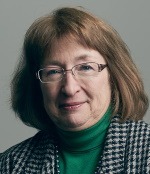
Susan Roll retired from the Faculty of Theology at Saint Paul University, Ottawa, in 2018, where she served as Director of the Sophia Research Centre. Her research and publications are centred in the fields of liturgy, sacraments, and feminist theology. She holds a Ph.D. from the Catholic University of Leuven (Louvain), Belgium, and has been involved with international academic societies in liturgy and theology, as well as university chaplaincy, Indigenous ministry and church reform projects.