
If I were standing in front of you preaching (and not tapping away on a computer keyboard) I’d look out at the congregation with a big mischievous grin and say,
If you remember this, sing along:
Pre–e–e–pare ye the way of our God.
Pre–e–e–pare ye
the way
of
our
God.
…which of course is the opening solo clarion call from the 1971 musical Godspell (OK, with a tiny tweak to the words.) We’d sing it through several times with gusto, and I’d promise you that you’d feel completely energized and just so good afterward, you could tackle anything.
The figure of John the Baptist appears in Matthew’s gospel account for the Second and Third Sundays of Advent in Year A. It’s easy to remember John by the distinctive characteristics (not to say clichés) in Matthew’s description: he wore ratty animal skins (probably soft furry camel’s hair), ate locusts (a good protein source) and wild honey (dripping with nutrients and antibacterial properties.) John the Baptist challenged people to change their lives with a dip in the river, and tore a strip off the local religious authorities for their hypocrisy.
What you might not see is that Matthew was casting John as a latter-day Elijah.
The author of Matthew was a Jewish Christian whose first language was Greek, and may have known Aramaic, Jesus’ native tongue. He would not only have been steeped in Hebrew Scriptures and stories, but acutely aware that there had been no widespread conversion to belief in Jesus among the now-scattered and defeated Jewish population. He must have counted his mission as a failure.
In Matthew, John’s appearance, message and actions marked him as the most recent prophet in the long line of revered prophets in Jewish sacred history. The prophet Elijah was believed to have ascended to heaven toward the East, on a chariot (meaning that he never died.) And as the story goes, Elijah would come again. This is why today, during the Passover Seder, little kids might be told “Listen! Did you hear knocking at the door? Maybe it’s Elijah! Run out and see if Elijah is here!” And a place at the table is set for Elijah, just in case.
There are two other aspects of this story that give it a rather different colouration than you may have heard. One has to do with what this latter-day Elijah came preaching: repentance. Up until the 16th century this word was translated as “penance,” as in, “do penance for your sins.” Well, it seemed to fit well enough. But when the great humanist scholar Erasmus translated the New Testament he used, for the Hebrew word shubh, (“metanoia” in Greek), conversion, a change of mind and heart, literally a turnabout.
This shift in meaning would influence Martin Luther’s thinking. When you think about it, the dignity of the individual who responds to the call is much better affirmed by this invitation. The point is not to punish oneself severely enough to get ahead of God’s punishment for one’s sins, but rather to change one’s mind. Turn one’s life around. (Not that it’s so simple.)

The other little quirk has to do with where you put the comma in the line about the wilderness. Does it mean something different if you say,
“A voice of one crying out in the wilderness, ‘Prepare the way of God!’”
or
“A voice of one crying out, ‘In the wilderness prepare the way of God!’”
It should, because the latter is more accurate to the Hebrew, in Isaiah. It’s not about the voice shouting from the wilderness, but the road to be built. Compare the equivalent text in the Gospel of Mark,
“Make straight in the wilderness a highway for our God.”
There’s a saying in the Black church,
“God makes a way out of no way.”
Now, take a deep breath, and sing “Pre-e-e-pare ye…” a couple more times.
Yes, out loud. Really loud.
Then take that positive energy and use it to make a way where there is no way.
© Susan K. Roll
*Revised from the Reflection of December 4, 2022
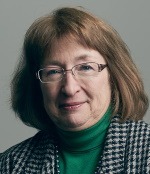
Susan Roll retired from the Faculty of Theology at Saint Paul University, Ottawa, in 2018, where she served as Director of the Sophia Research Centre. Her research and publications are centred in the fields of liturgy, sacraments, and feminist theology. She holds a Ph.D. from the Catholic University of Leuven (Louvain), Belgium, and has been involved with international academic societies in liturgy and theology, as well as university chaplaincy, Indigenous ministry and church reform projects.