
I have always loved the reading from Isaiah 9:2-7. It sounds a clarion call to proclaim light, and hope, to congregations shrouded in the dark of Christmas Eve, in the hour before they light the candles in their hands.
“The people who walked in darkness have seen a great light.”
There is a pounding, thumping rhythm to the lines in verse 5,
“Every boot that tramped in battle, every cloak rolled in blood,
Shall be burned as fuel for the fire.”
How might we say it in our world today?
“Every boot that pressed down on the neck of a protestor,
Every balaclava concealing the identity of an officer,
Shall be incinerated.
For a child is born to us…”
The author called Matthew of this Sunday’s Gospel did not just cite Isaiah but shaped the story of Jesus in ways that aren’t apparent to us today. He gave a distinctive cast to his theology of Jesus’ early ministry. The Greek word translated “withdrew,” as in, “he withdrew to Galilee” doesn’t mean Jesus left. It implies that Jesus set up shop in a house there – he wasn’t just passing through.
And the region wasn’t called Zebulun and Naphtali anymore – by that time those names were obsolete. But they were in current use in the time when First Isaiah was composed. They referred to, respectively, an area in southern Galilee and the northernmost part of the kingdom of Israel. In the year 733 BCE this region was invaded and conquered by Assyria, and suffered all the bleak consequences of military occupation, political dissolution, social and religious devastation, and slaughter — a time of darkness. This forms the background of the breathtakingly beautiful “The people who walked in darkness have seen a great light,” a hymn of thanksgiving to the God who saved and delivered them in their despair.
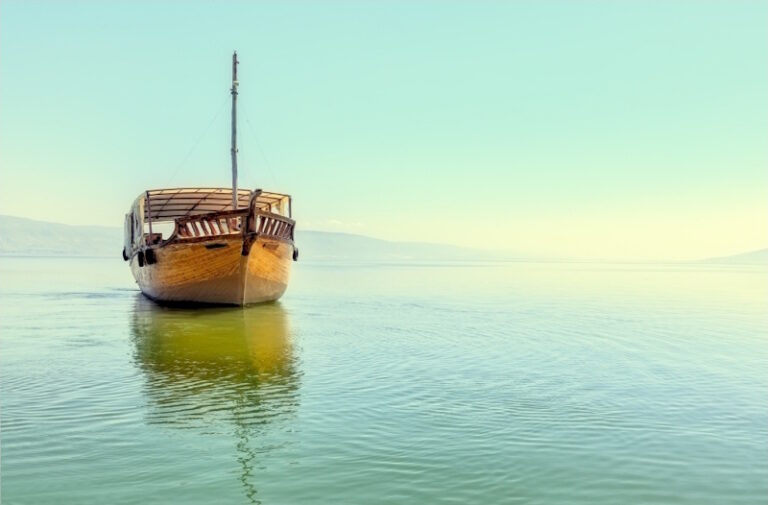
Galilee would be a perfect setting for the beginning of Jesus’ public ministry. In this telling, Jesus didn’t start at home in Nazareth. Instead he was living in a foreign land whose population was half Gentile, bilingual Greek/Aramaic, and whose local culture was characterized by the worship of Greek gods and other deities. It was far enough from Jerusalem to be outside the direct control of the religious authorities. It flourished at the confluence of major trade routes.
He strikes up a friendship with some local fishermen. These men are practicing a profession that only thrives because they are bound by the terms of their contracts with local Roman officials to deliver a certain quantity of fish for a predetermined price. Their position, while dependent on the occupation government, was stable. When Jesus invites them to “fish” for people, they become economically and socially vulnerable. The stakes were even higher for the second crew, who left their father behind in a society in which kinship ties determined the entire social structure.
Matthew makes explicit that the lands which suffered first from the Assyrian invasion in the eighth century BCE, and were the first to “see the great light,” are now the lands in which the new light, the new promise of deliverance from evil, was first given. And the new promise was made, not by a powerful king or a military leader, but a preacher who travelled the local roads and healed the sick.
Scripture scholar Benedict Viviano O.P. writes,
“Matthew uses the old Israelite tribal names … because he wishes to defend the activity of the Messiah in this unexpected place rather than in the religious capital Jerusalem or in the desert.”

As you shut off the TV news or set aside your phone, it may feel like we’re living in a desert today, with darkening clouds presaging something disastrous.
Let’s write a hymn of encouragement and hope-against-hope for our own time:
“Unto us a new generation comes to birth.
And the government will be upon their shoulders.
And they shall be called wonderful counsellors, truthful protectors,
faithful allies, makers of peace.”
© Susan K. Roll
*Revised from the Reflection of January 22, 2023.
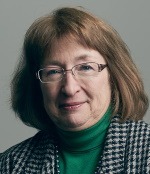
Susan Roll retired from the Faculty of Theology at Saint Paul University, Ottawa, in 2018, where she served as Director of the Sophia Research Centre. Her research and publications are centred in the fields of liturgy, sacraments, and feminist theology. She holds a Ph.D. from the Catholic University of Leuven (Louvain), Belgium, and has been involved with international academic societies in liturgy and theology, as well as university chaplaincy, Indigenous ministry and church reform projects.