
When I was ten years old, my aunt gave me a subscription to a natural history magazine. It wasn’t one of my big interests at the time, but I did read it cover to cover every month.
One day I came to the end of the issue, and splashed across the inside back cover was a huge photo of a coiled rattlesnake, glaring with hideous evil in its eyes and fangs. I shrieked, dropped the magazine and took a few steps back. My heart was pounding in fright. After a few moments, I picked up the magazine by the corner and dropped it in the wastebasket. I could still see a glimpse of the snake’s coils.
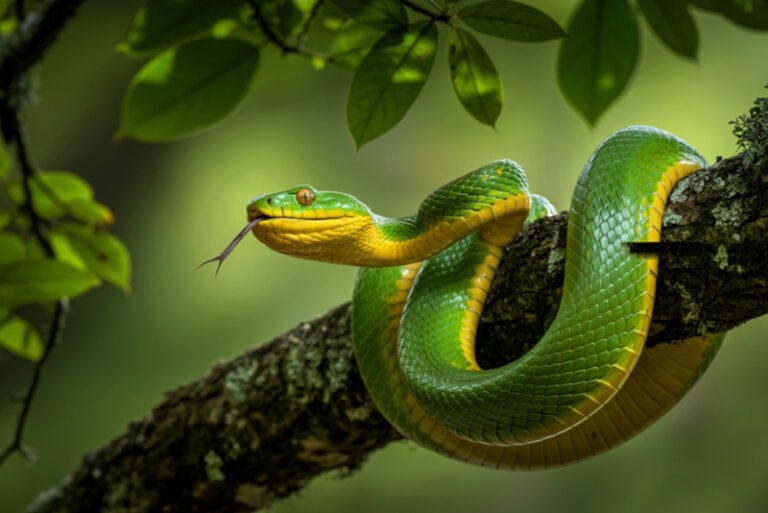
What is there about a photo – a photo!—of a poisonous snake about to strike, that would call up a rush of visceral, primordial terror? It wasn’t as if rattlesnakes were common in my area – just the little garden snakes that would slither away from the vibration of human footsteps, or dash away even faster from a lawnmower.
I think we first need to remind ourselves that this is a story – an explanatory myth. Imagine that the family has had supper, the elders have gathered the children around the fire at dusk, and a grandparent looks around the circle with big eyes and says,
“Do you know how evil came into the world? Well, once upon a time…”
And you know, this is not the only talking snake in the history of world literature, or even animated film.
But there’s just something about snakes: they’re used as a symbol of the medical profession, they have a long association with wisdom, but of course they look like the very personification of cold, vicious evil. It’s not that they’re slimy – a snake’s skin is actually rather pleasant to stroke … carefully …
In the story, the “temptation” posed by the snake is that of knowledge of good and evil, and the power that knowledge can bring. Let’s unpack this. Why is seeking knowledge supposed to be evil? Why does a thirst for knowledge lead to eternal exile from the primordial garden? Why is distorted or falsified knowledge used as propaganda to control entire populations? Because knowledge really is power. Powerless persons, minorities, could be kept under control by the ruling class if they were denied knowledge. In the 19th century U.S. it was illegal to teach enslaved persons to read and write. For centuries women were ridiculed if they wanted to study, denied access to the tools and resources for higher education, never mind the professions. Women were thought to be “too weak for Greek.” Study was believed to damage their reproductive organs.
Are we supposed to seek divine mercy for the “sin” of seeking knowledge? Cui bono? Who benefits from that?

Interestingly, this story in Genesis 2 has been structured with a number of elements that come straight from ancient wisdom traditions. Scripture scholar Dianne Bergant writes,
“This story is filled with allusions to wisdom. First, Eden is in the east, considered the place of enlightenment because the sun rises there. In the middle of this garden, which was the source of delight and nourishment, was the tree of life. The Hebrew construction suggests that the mention of the tree of knowledge, a second allusion to wisdom, was an addition, probably included when the originally separate stories of the garden and the sin were brought together.”
And why the woman? Because women were associated with wisdom? Because women were derided as gullible? Because she becomes an easy scapegoat? Because the man blames the woman and the woman blames the snake?
Maybe it’s time to de-fang the snake.
In my fifties I discovered that the sight of a snake didn’t have the same effect.
“Oh, look at that, it’s not a stick, it’s a snake. Oh my. Let’s see if it moves.”
And I’d gently pursue the snake with the lawnmower until I’d sent it scurrying under the fence and into the neighbour’s yard.
© Susan K. Roll

Susan Roll retired from the Faculty of Theology at Saint Paul University, Ottawa, in 2018, where she served as Director of the Sophia Research Centre. Her research and publications are centred in the fields of liturgy, sacraments, and feminist theology. She holds a Ph.D. from the Catholic University of Leuven (Louvain), Belgium, and has been involved with international academic societies in liturgy and theology, as well as university chaplaincy, Indigenous ministry and church reform projects.