
Sometimes it’s funny the things you remember vividly. Even from decades ago.
One summer evening in the mid-1960’s my uncle took my mother and me, plus two aunts, to see George Bernard Shaw’s play “The Apple Cart” at the original Court House Theatre in Niagara-on-the-Lake, Ontario. The star players were Zoe Caldwell and Paxton Whitehead.
We were driving home after dark on a fairly deserted two-lane road that wound alongside the Niagara River. Suddenly ahead, we saw several cars pulled over at odd angles, and flashing lights. There had been an accident of some sort. My uncle wondered if we should stop to offer help.
But my mother protested,
“You don’t know if it might be a set-up. They might rob us. You hear about that happening.”
We swerved to avoid the vehicles and drove on.
So I’m sitting there in the car, with all the wisdom of my fourteen years, thoroughly puzzled. Weren’t we supposed to stop and help somebody who might be injured by the roadside? Didn’t we hear that in church? I kept quiet and just sat there pondering the incident, muddled in cognitive dissonance.
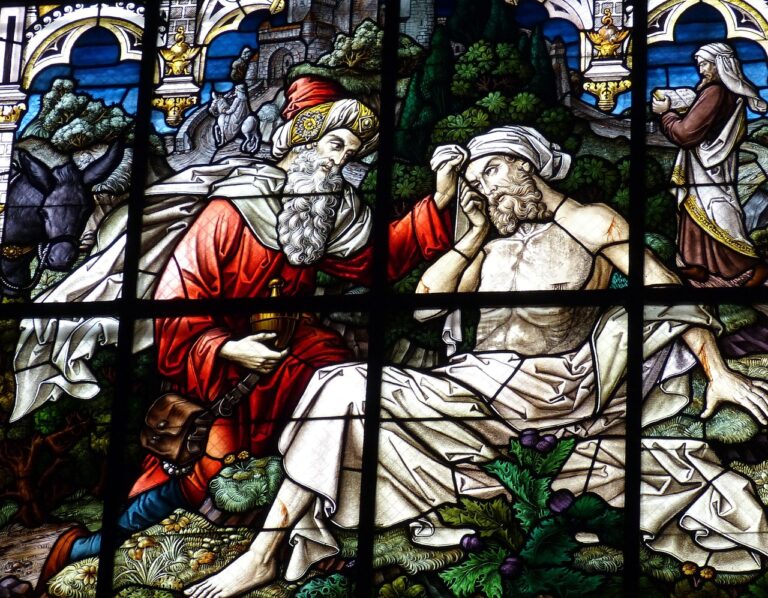
And that of course brings us to the story of the Good Samaritan.
Jesus tells the story to illustrate a point, or more accurately, to provoke a change of identity in the lawyer who sought to provoke him. The change was not about the victim, or the three different passers-by, but rather in the questioner himself. His challenge (one can almost hear him sneering) to Jesus was thwarted. The virtuous and generous neighbour in this story was an “enemy of the people.” The honoured dignitaries failed to act according to higher religious (and human) values. The lawyer’s conventional image of society was turned upside-down, and out of that emerged a startling image of the abundant and merciful God. A compassionate, healing God.
A number of New Testament interpreters have emphasized the idea that the priest and the Levite set a higher priority on maintaining their cultic purity in view of their religious duties, and for this reason they would not come near the injured and bleeding victim. However, if they, like this man, were going down from Jerusalem to Jericho, they were travelling away from the Temple, not toward it. Their callousness toward the victim cannot be reasoned away so easily.
Another factor that’s not often highlighted is that the Samaritan was clearly a man of means. He was mounted on an animal, not journeying on foot. He had supplies of wine and oil with him, and he carried enough cash money to pay the innkeeper on the spot. Clearly the Samaritan himself did not fear being assaulted and robbed along that road.
The story focuses exclusively on the actions of the Samaritan traveler, but doesn’t mention whether he was accompanied. Did he have companions? A servant?
Did the Samaritan stop to wonder whether robbers were lurking in ambush as he struggled to bandage the victim and hoist him onto his donkey? Was he at risk?
We really do have an uncomfortable balance to make here – to be compassionate and merciful toward the victim on the one hand, and cautious in assessing the likelihood of a dangerous threat to oneself or others, on the other. What is the faithful choice? What is the wise choice?
There’s much to be said for being as clever as serpents and innocent as doves.
© Susan K. Roll
*Revised from the Reflection of July 10, 2022.

Susan Roll retired from the Faculty of Theology at Saint Paul University, Ottawa, in 2018, where she served as Director of the Sophia Research Centre. Her research and publications are centred in the fields of liturgy, sacraments, and feminist theology. She holds a Ph.D. from the Catholic University of Leuven (Louvain), Belgium, and has been involved with international academic societies in liturgy and theology, as well as university chaplaincy, Indigenous ministry and church reform projects.