Indigenous and Community Relations Circle
Journeying together towards healing, reconciliation and right relationships with All
April 2025 ICRC Digest Issue 009
Dear Sisters,
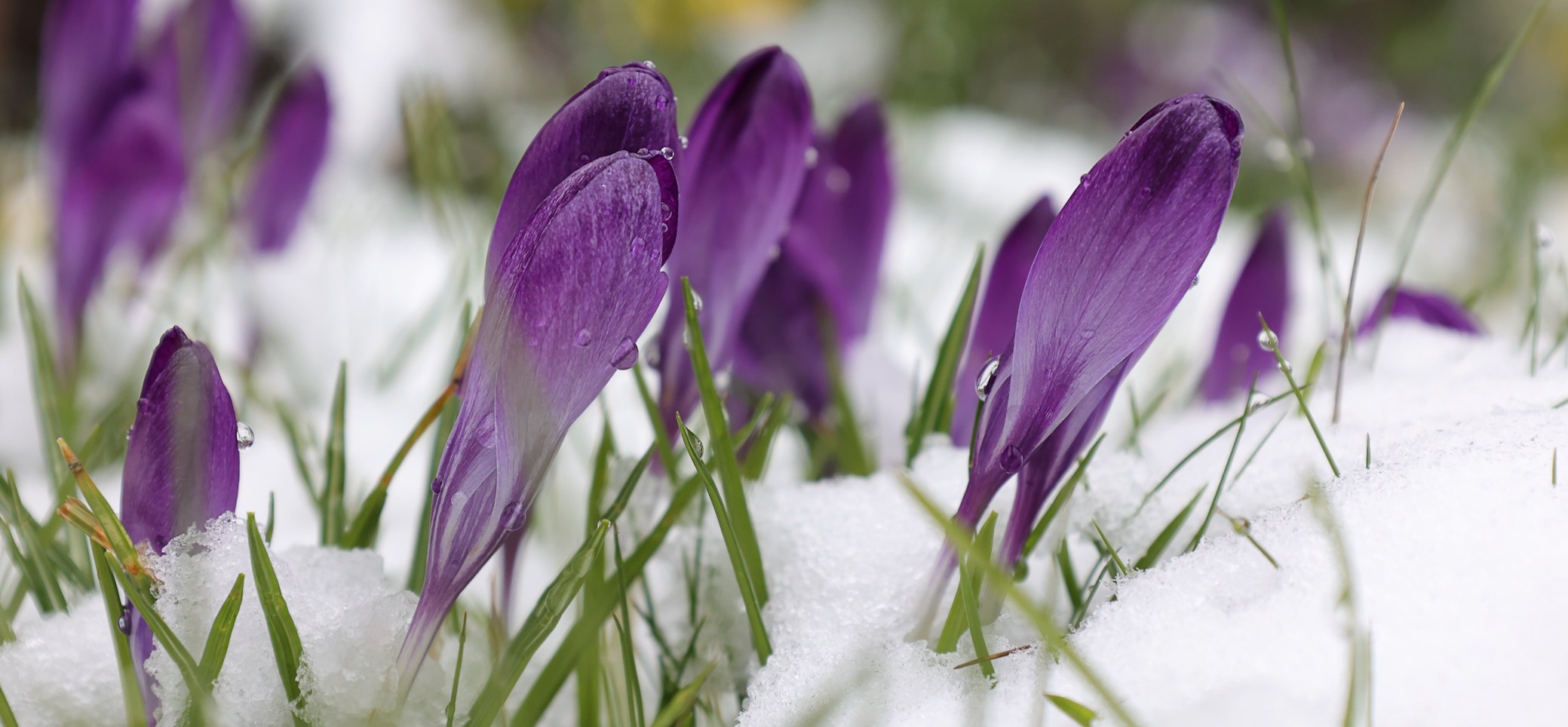
Greetings to you during this Easter season with new life hope and trust in the Lord. We have been waiting to spring to arrive. We can see now ground smiling with new shoots coming forth which were asleep for a while. Our neighbor’s lilac plant is a home for hundreds of sparrows are now joyful, we can see from our kitchen window. And the crocuses on the ground are the best way to
welcome the spring. Together with that we bring to you our past months’ experiences and participation from our ministry. Have a wonderful reading time.
The Experience of Making Fried Bannock
by Thuong Truong, RNDM
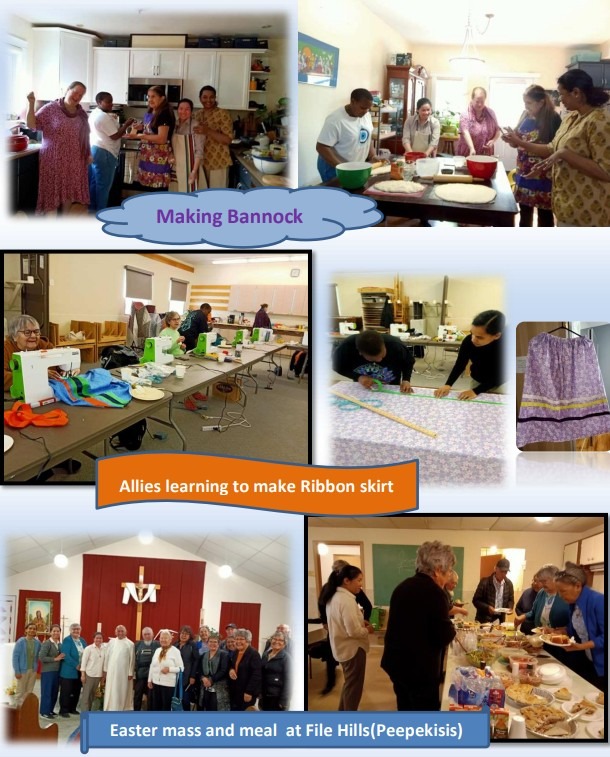
A lot of things happen around here, and I would like to share my experience of joining the group that makes fried bannock, or fried bread. Baked bannock or fried bannock is a traditional food for Indigenous people. When they have a feast, they often serve bannock and soup, sometimes with jam and butter.
It wasn’t my first time learning how to make it, but every time brings a different experience. Kokum Doreen guided us, and we each had our own bowl to start with. We put all the ingredients into our bowls and mixed them together.
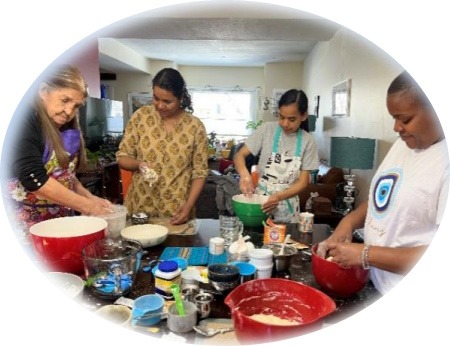
We followed Doreen’s instructions, but in the end, our bannock turned out quite differently. Some rose very well, and some didn’t. Why do I say that? Because I observed that some of us over mixed the dough, some added too little or too much water and I pressed mine down too much. But we had a lot of fun.
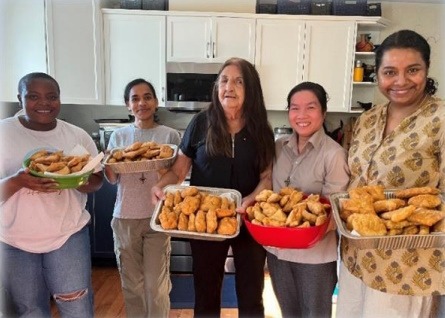
I learned many things during that hour. I realized that each ingredient plays an important role, just like each person in a community has an important job. We are all unique, even though we are so, so different. Like dough resting before it rises. I have hope and it reminded me of Jesus in the tomb for three days—in darkness, in silence, and waiting… Sometimes, I need to be silent, to rest, and to just be with God.
The challenging moment came when I put small pieces of dough into the hot oil, and they transformed into fried bannock.
The hot oil became a time to let old thoughts die, so that something good could come out. A time to let go, so I could receive good news. A time to endure and challenge myself—to be patient, to accept and love others. And a time to celebrate and be with one another.
At the end, each of us took some of our fried bannock and placed it in a common dish, sharing a meal together, full of laughter and happiness.
Making My Own Ribbon Skirt
by Pricilla Lugun, RNDM
Last month I was very fortunate to make my own Ribbon skirt. When Susan Beaudin (Chairperson of TRC committee) announced that anyone wants to make a Ribbon skirt are welcome to register your name, I thought to myself this will be perfect opportunity to make one for me. She also added they must know the sewing. Realizing how little I knew sewing, I would be the last person to finish or won’t be able to do. Even though I knew very little, I registered my name hesitantly. Only sewing that I did was when my clothes were torn. When the day arrived I packed a bag with needle, pins, treads and colorful ribbons with a piece of cloth and headed towards the Neil Balkwill Civic Art Center.
We had Tracy, a lovely indigenous woman, expertise in making Ribbon skirts, helped us coordinate that day. Best part about the day, together with making the skirt, was to listen to the story and the importance of the Ribbon skirt. She shared, the existence of the ribbon skirt stories might vary from community to community. But it is very significant for the First Nation women to wear a Ribbon skirt. It shows their identity, culture, respect and resilience as a strong woman of the First Nation. When we see a TP’s wrapped around with the clothes or animal skin touching the mother earth it represents the skirt. This brings warmth and protection. So also the skirt brings warmth, and protection.
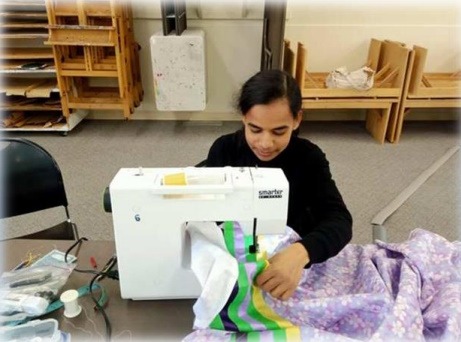
Here are some of the things she said to remember while wearing them:
- Wear them at events like Powwow, ceremonies, even at public offices.
- Make for your own family members.
- To be respectful and valued when wearing them.
- Not to wear at beaches or bars as it brings disrespect.
- Non-Indigenous people should not to start a business making these skirts.
I would say it was an awesome day, making a ribbon skirt. We had fun, laughter and I felt one with the First Nation community. Even though I was very late in finishing them I did it wholeheartedly. I feel very proud that I did one and am waiting to wear them at powwows next time.
Personal Experience with Indigenous Sacred Liturgy: St. Kateri Church - Winnipeg
by Jacinta Dkhar, RNDM
I love the smell of sage and sweet grass. Each time I enter the sacred space, I’mreminded to first cleanse myself of any feelings of unworthiness beforeparticipating in the Eucharistic celebration. Thisact of liturgy helps me feel connected to all of God’s creation especially my family, my Congregation, and the people I know andengage with at church.
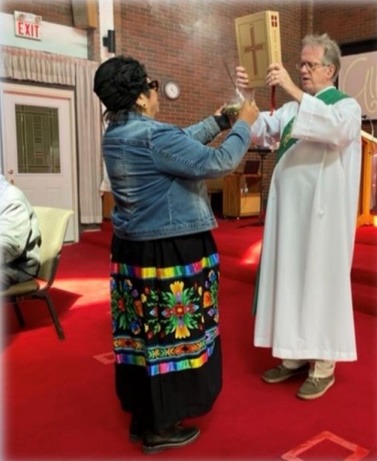
As a sacred act of preparation and purification, the Smudge Ceremony holds a central place in Indigenous worship. Before entering the sacred space, each person is invited to smudge gently sweeping sacred smoke over their body to cleanse the mind for good thoughts, the ears to hear truth, the eyes to see clearly, the mouth to speak uplifting words, and the heart for actions rooted in love and the Creator’s laws.
In place of traditional holy water, this ritual honors the space and the sacred moment. As the community gathers, an elder or lay leader carries the smudge around the entire church, invoking peace and unity, and asking the Creator to fill the place with the spirit of prayer. Sacred items drums, instruments, and liturgical objects are also smudged, recognizing their role in divine worship.
At funerals or wakes, the body of the deceased may be gently smudged symbolizing a farewell, a healing, and a blessing for the journey into the Spirit World. The sacred smoke comforts those present, wrapping them in communal prayer and remembrance.
During Eucharistic celebrations, a special ritual replaces the traditional incense at the Gospel procession. Beginning at the entrance, an Indigenous lay minister leads the procession with the smudge. The altar, the Book of the Gospels, and the reader are all smudged, honoring the sacred word and those who proclaim it.
The Smudge is more than a ritual it is a living prayer of healing, respect, and connection with the Creator, with one another, and with all creation.
Sisters of Our Lady of the Missions
393 Gaboury Place
Winnipeg, MB
Canada
R2H 0L5
Phone: (204) 786-6051
Fax: (204) 691-0640