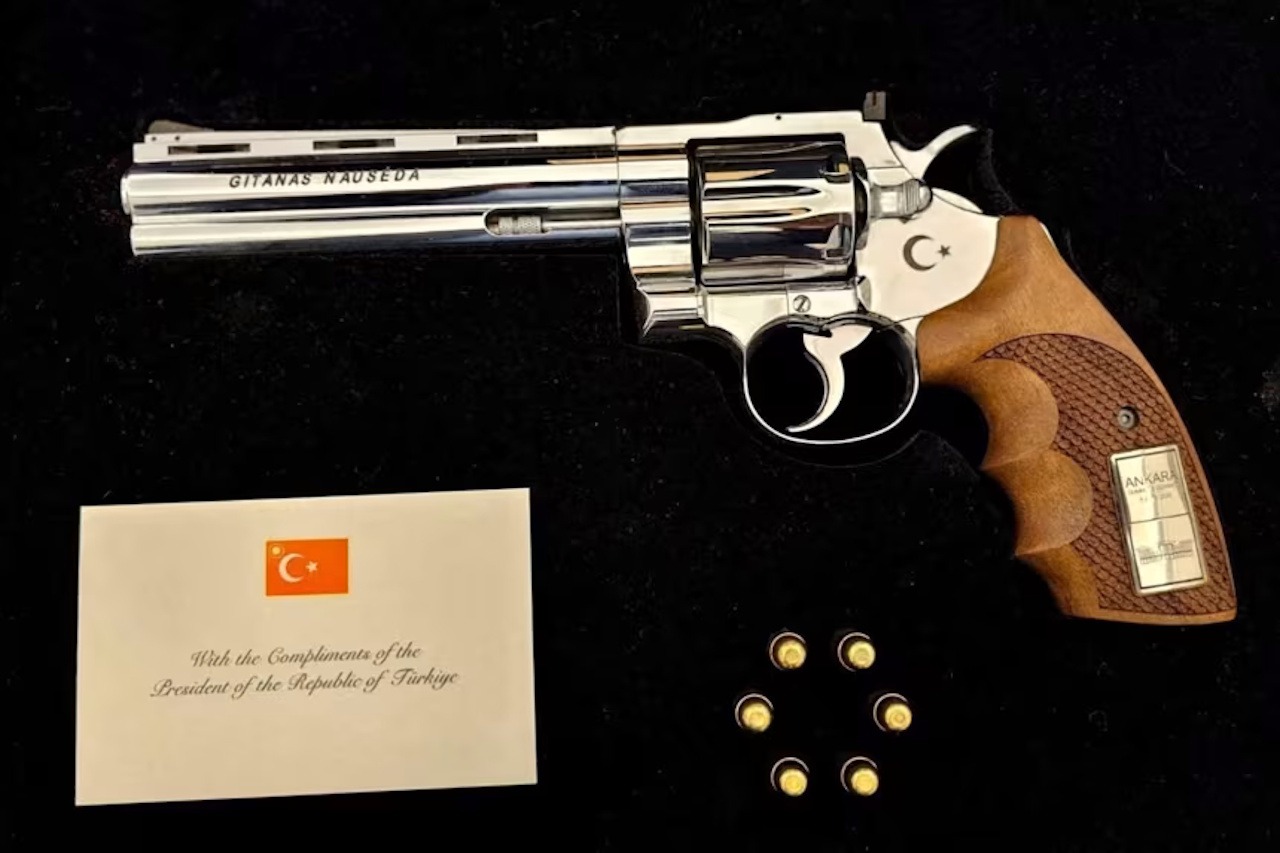
Following the recent NATO Summit, Metropolitan Archbishop of Naples, † Don Mimmo Battaglia, issued a powerful reflection after Turkish President Recep Tayyip Erdoğan presented commemorative firearms to NATO leaders as diplomatic gifts. We are pleased to share this English translation of his message, “Evil That Learns Good Manners,” so that his prophetic call for peace and human dignity may reach a wider audience. His words invite us to reflect on the values we honour, the symbols we celebrate, and the kind of world we are helping to create.
Don Mimmo Battaglia writes to the powerful of the earth:
To the powerful of the earth, peace be with you!
Evil does not always come barging through a door.
Sometimes it enters silently.
It wears an elegant suit.
It smiles for the cameras.
It is placed in a case, accompanied by a note, and presented with all due honours.
And for a few moments, no one recognizes evil anymore, because it has learned good manners.
This is what wounds me about the gesture made in Ankara: not simply a gun presented to representatives of NATO countries, but death transformed into a courtesy. The capacity to take a life has become a souvenir, an official memento, an object to be displayed.
We have domesticated weapons to the point where we can give them as gifts.
This is the real scandal.
You tell us it is a symbol. But it is precisely symbols that help shape the world. They come before laws, penetrate deeper than speeches, and silently teach what a civilization considers normal.
And that gift teaches that power must be recognized in the metal of a gun. That people of influence are people who are armed. That among leaders, one can pay homage by elegantly bestowing upon one another the possibility of death.
The name of the person receiving the gun was engraved on the barrel.
But every gun always bears a second, invisible name.
It is the name of the person at whom it might be aimed.
The name of the person who might be left without a partner.
The name of the child who might wait in vain for a parent’s return.
The true recipient of a weapon is never simply the one who receives it. It is also the unknown person who might one day be struck by its bullet.
That is why I cannot view that gesture as a mere diplomatic eccentricity. It reveals a particular worldview: one in which security is measured by counting weapons, without asking how much fear must be sown to maintain it. A world that calls mutual terror “balance” and the interval during which no one has yet fired a shot “peace.”
As a Christian, I cannot accept this.
The Gospel has given us a different image of power.
Christ, on the night when everything might have compelled him to defend himself, did not place a weapon in his disciples’ hands. He wrapped a towel around his waist, knelt before them, and washed their weary feet.
On the one hand, a weapon offered while standing among powerful people.
On the other hand, God kneeling before humanity.
These are two visions of civilization.
We must choose.
We Christians are not naïve. We know violence. We encounter it in abandoned neighbourhoods, in homes where there is no bread, in the bodies of migrants, and in children returned to their families in coffins. We know that evil exists. Precisely for this reason, we refuse to make it look elegant. We refuse to adorn it, polish it, or transform it into a sign of prestige.
A weapon does not become innocent simply because it is given as a gift.
It does not become harmless simply because it does not fire.
It does not become humane simply because a name is engraved on it.
I therefore ask you, the leaders of nations, not to cherish that gift as a trophy. Do not simply place it in a room, out of sight, as though hiding a symbol were enough to erase its meaning.
Do something more difficult.
Reject the idea that death can be a form of tribute.
Say publicly that no pact between peoples needs to be symbolized by a gun. Say that a nation’s dignity is not measured by the amount of fear it can instill. Say that security is not the privilege of those who can shoot first, but the right of every person not to be shot.
And at the next summit, leave a chair empty.
Not for a president, not for a general, not for a minister.
Leave it for the unnamed person who so often pays the price for decisions made by those in power. For the person who does not attend summits, sign treaties, or appear in photographs, but may end up beneath the rubble when diplomacy fails.
Look at that chair before you talk about weapons.
Perhaps then you will understand that peace is not a weakness to be corrected, but a responsibility before which to kneel.
Because power that does not know how to kneel before life will always end up kneeling before weapons.
And on that day, no matter how solemn the ceremonies may be, we will all have already lost.
† Don Mimmo Battaglia
Metropolitan Archbishop of Naples
Translated with DeepL.com (free version)

Veronica Dunne is a Sister of our Lady of the Missions (RNDM), who has primarily worked as an educator and counsellor in institutional and community based settings in Canada. She has also served with the RNDMs outside of Canada in Senegal, Peru, and Aotearoa New Zealand.
A 2002 Doctor of Ministry graduate from the University of St. Michael’s College, Toronto School of Theology at the University of Toronto, she subsequently served as director of the Doctor of Ministry program at St. Stephen’s College at the University of Alberta in Edmonton. Her current research interests are in eco-theology and cosmology, and their intersections with indigenous cosmologies and spiritualties.
She presently serves on the RNDM leadership team in Canada.


Veronica, thank you for sharing this message, which I don’t think I would have seen otherwise. What a powerful message Don Mimmo Battaglia has given — to world leaders and to all of us. I felt so uncomfortable, repulsed by it when I heard about the presentation of these “gifts” by the Turkish president. This reflection has helped to clarify for me why it was so wrong.
Thanks Veronica for this powerful and challenging reflection.
Way to speak up my friend! Superb article. Thank you for taking the time to point out the world needs peace not power through weapons.
What a searing message for “the powerful of the earth”! I hope that each of the NATO leaders had an opportunity to read it. I, too, would not have seen this without your posting. Thank you, Veronica.