The year was 1990, the place was the Pontifical Liturgical Institute in Rome, and the event was an international symposium of scholars and professors of liturgy and worship on the topic of the “Inculturation of the Liturgy.” A well-respected Benedictine scholar from the Philippines was speaking in a small discussion circle.
The professor said,
“In the Philippines where I come from, it would be an unthinkable social fault if the host started to eat before the guests. This is why, when we celebrate the Eucharist, the congregation is invited to come forward to receive communion first. The presider only communes afterward.”
If I remember right, there was an audible gasp of shock. Could this eminent Roman Catholic scholar possibly be advocating that parishes violate liturgical law? Quel horreur!
Now, 36 years later, I could not possibly count all the times I have participated in liturgies in which the presider waits until all have received communion. Only then do the presider and communion ministers receive.
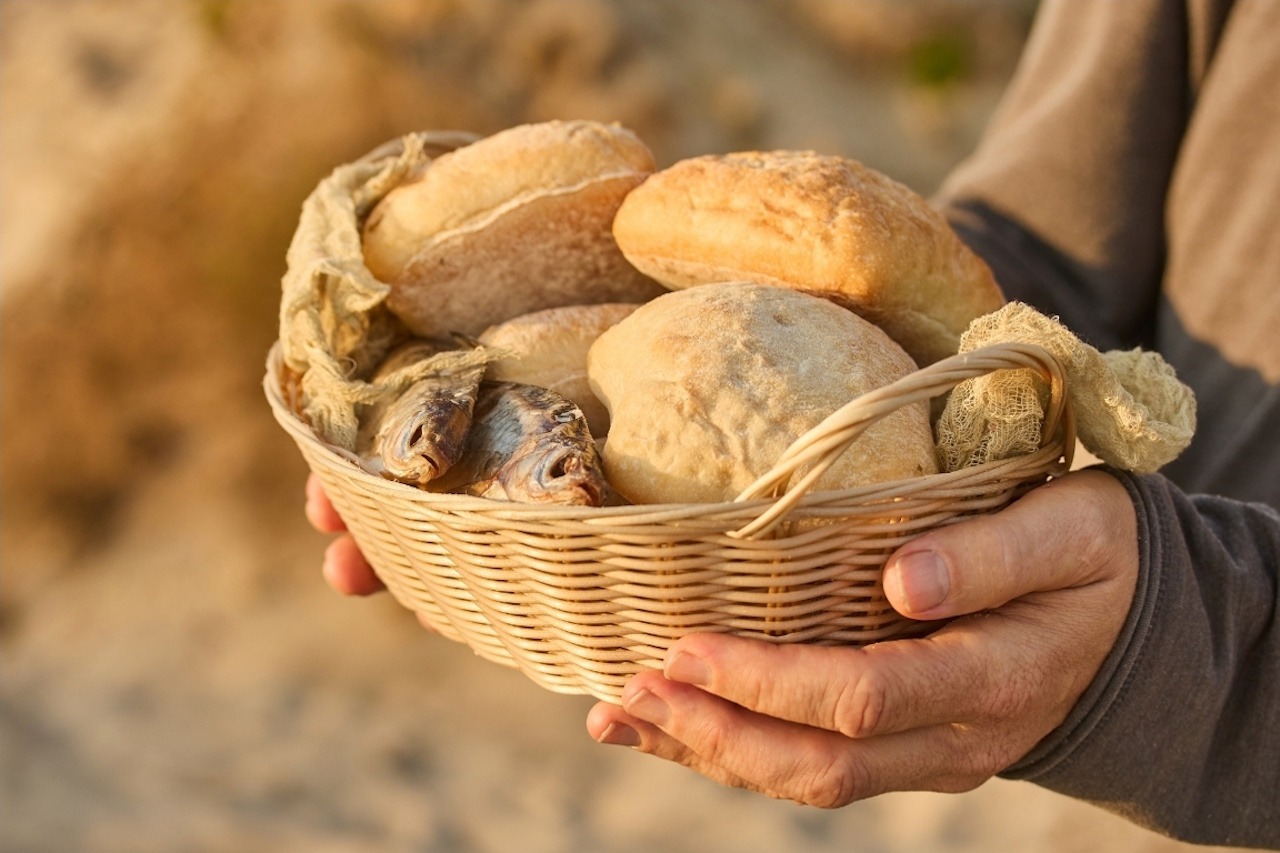
It was never recorded whether Jesus waited until the thousands of people had eaten before he sat down with his own meal of fish and bread.
But Matthew does record a small detail that’s more positive than it appears at first glance. All four canonical Gospels relate a story of the superabundance of bread and fish at Jesus’ behest, but Matthew adds that the number fed was five thousand – men: not counting women and children.
As disconcerting as it sounds to us, there may be an inspirational point here. In this time and culture, the custom at the daily full meal was that the men of the family would be served first, and only afterward would the women and children eat from the leftovers. No word on whether there was enough for all. But in this wilderness setting and among this huge crowd, beginning with someone’s modest lunch, there was far more than enough for all. Twelve baskets more.

Some years ago theologian Rosemary Radford Ruether proposed a very common-sense understanding of what may have happened in this deserted place by the lake. One person had come forward with their lunch, five small loaves of bread and two fish. Jesus sat the crowd down, said a blessing over the food, broke it into pieces and handed them to the disciples to distribute. Ruether suggests that Jesus’ example inspired those present to start pulling out the food supplies they themselves had brought along, and to share them. This makes sense.
Of course mothers would have packed food supplies for the family, especially considering it was some distance to nearby towns. Of course, once all the food was pooled and passed around, there might have been a considerable amount left over. And of course there would have been empty baskets to collect the leftovers (where would those twelve baskets have come from otherwise?).
What a marvelous message, that at Jesus’ initiative it was precisely the poor ones, those who would eat last in that society if any food was left – the women and children – who carried out the food ministry among the crowd. It was precisely the ones who didn’t “count” who made the miracle happen. No wonder there was plenty to go around.

I remember there was a good deal of shock when Ruether’s interpretation was first published. It sounded as if Jesus’ divine power was being taken down a peg. Yet the message here is powerful enough: God levels out distinctions between rich and poor, when all share. And God is more than equal to all human need, whether physical or spiritual.
In the end, this is so much like the Jesus we know: sometimes you have to take the initiative, fly in the face of custom, or break an unjust law, to do the work of justice.
What if true holiness begins when you share your lunch?
© Susan K. Roll
*Partly taken from the Reflection of August 6, 2023

Susan Roll retired from the Faculty of Theology at Saint Paul University, Ottawa, in 2018, where she served as Director of the Sophia Research Centre. Her research and publications are centred in the fields of liturgy, sacraments, and feminist theology. She holds a Ph.D. from the Catholic University of Leuven (Louvain), Belgium, and has been involved with international academic societies in liturgy and theology, as well as university chaplaincy, Indigenous ministry and church reform projects.