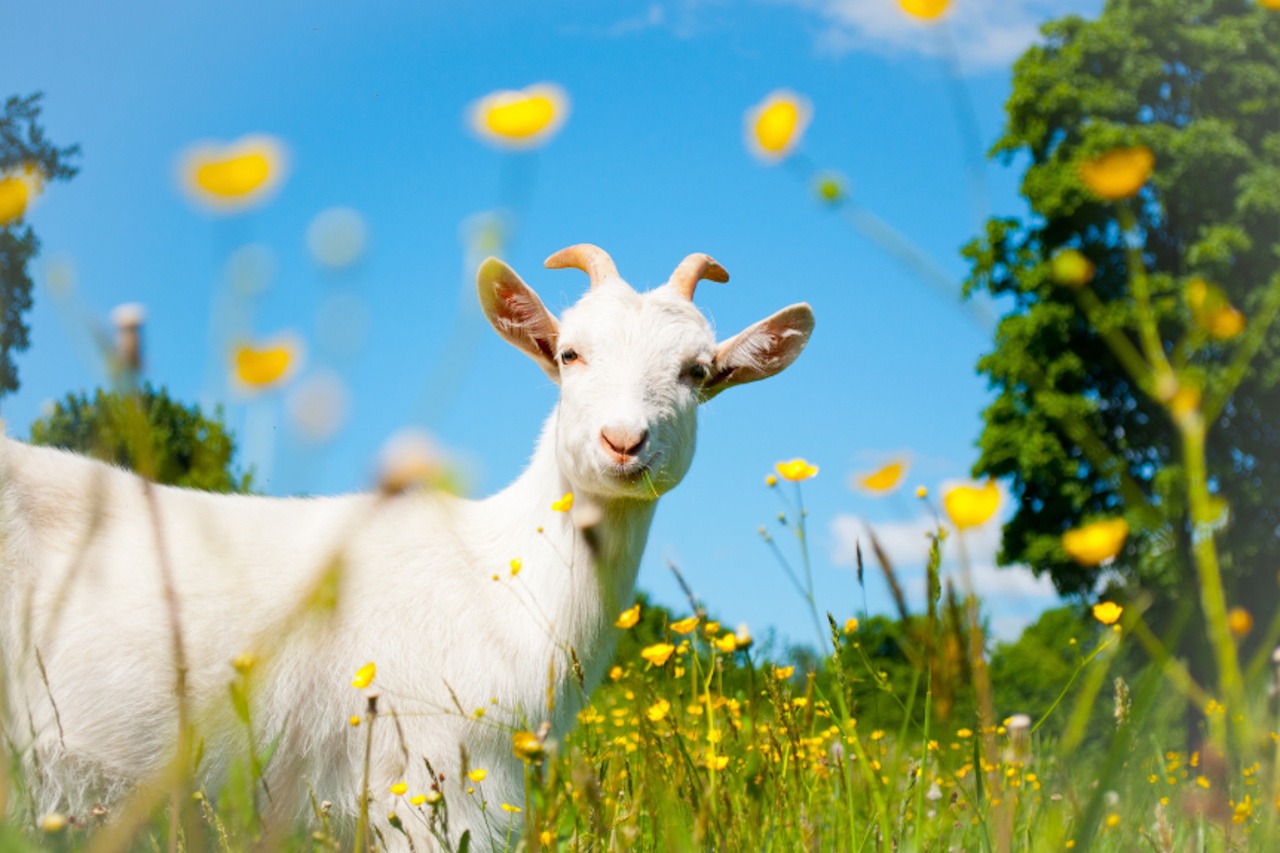
Let us all now raise our voices in praise of – goats. Yeah, goats. Not the most fragrant of animal companions. But apparently one of the most empathetic.
A young woman named Alice Clarkson lives on a small farm in the village of Colden (New York) with her family. On her birthday her husband gifted her with two young goats, thinking that, because she was a cook and caterer, she’d like to try making goat cheese and yogurt. She noticed how sweet and affectionate they could be, and she acquired more goats. During the pandemic shutdown, a friend of hers whose son was struggling asked if she could bring him out to the farm to spend time with the goats. The animals took to the boy right away, and not long after they all snuggled up together and went to sleep.
Before long more families whose children were affected by the isolation came out to be with the goats, and so did a local therapist who worked for a rehab program.
She now has 32 goats and more than 150 bookings per week, all free of charge. Her clients include Wounded Warriors and children from local mental health clinics. She supports the goat therapy program by making and selling goats milk soap, 25,000 bars per year, enough to support the program and the farm itself.*
In other places there’s such a thing as goat yoga. Let’s not underestimate goats.
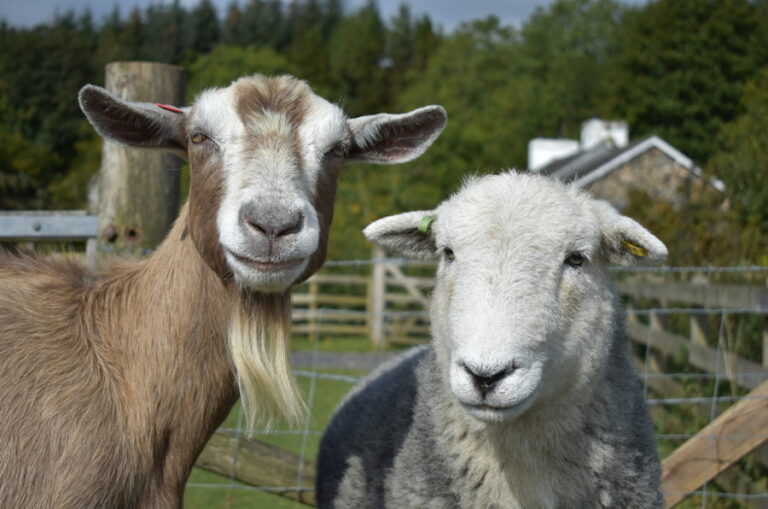
Our Gospel today is Matthew’s account of Jesus describing the final judgement. This story is not a parable like the others we’ve been hearing in the Gospel the last few weeks. This story is intended to present a vivid picture of a reckoning, of a justice-making, at the end of time when Christ comes again. Matthew is the only source for this story.
The words that Matthew uses for “sheep” and “goats” are more muddled in their meaning than just two different species, according to commentator Catherine Cory. “Sheep” in Greek could mean any small adult grazing animal. The word for “goat” means “little wooly creatures,” not full grown. In this sense, the goats are the ones not yet mature—in our perspective, not mature in their faith, or in the way that they treat others. And what is the measure of this maturity in faith? It’s precisely how you respond to others, especially those in need. It’s about ethical behaviour. It’s about compassion. It’s about the heart of Jesus.
Too often what we hear in this text is not compassion, but a harsh and unmerciful final judgement. Eric J. Wagner CR comments,
“Jesus indicates that a single, fundamental distinction will be made at that last judgement. Some will be sheep who are worthy of the Father’s kingdom [sic]. As such, they will enjoy blessedness and eternal life. Others will be goats and destined for eternal punishment. In either case, resurrection extends to all, not just the blessed. However, the quality of one’s resurrection will vary.”
(As a theologian, I have no idea where this latter notion came from. A resurrection to hell?)

I think the real challenge here is to be as empathetic and compassionate to those in special need as goats are. Cats, dogs, horses, are all capable of similar support when their trusted humans are in distress. But the ethical duty of care for humans by humans can be very precise according to this reading:
- to provide food for those who go hungry, perhaps whose money runs out by the end of the month, or who live in food deserts;
- to give water to those living in drought conditions or hot climates, those whose crops are failing or whose waterways run dry;
- to welcome migrants, refugees and the homeless;
- to provide clothing for those who have nothing, or not enough to protect them;
- to tend to the sick with medical care and support;
- to visit prisoners with pastoral care or just human contact.
As to the final judgement and the threat of eternal punishment: last weekend I was a guest at a Jewish Shabbat service. In the buffet line afterward, I got to talking with a gentleman about the Holocaust. I said that I had visited and prayed at most of the concentration camp memorial sites, with a sense that I was looking into the face of absolute evil. The man replied,
“Did you know that Jews do not believe in hell? We don’t believe Hitler is in hell.”
I’ve pondered that often these past days.
© Susan K. Roll
*Diane Nichols, “A new calling led her to start a therapy goat farm!” in Woman’s World, August 3, 2026, pp 10-11.

Susan Roll retired from the Faculty of Theology at Saint Paul University, Ottawa, in 2018, where she served as Director of the Sophia Research Centre. Her research and publications are centred in the fields of liturgy, sacraments, and feminist theology. She holds a Ph.D. from the Catholic University of Leuven (Louvain), Belgium, and has been involved with international academic societies in liturgy and theology, as well as university chaplaincy, Indigenous ministry and church reform projects.