“Cherchez la Sagesse…”
“Seek Wisdom, while she may be found. Call her, when she is near… For my thoughts are not your thoughts, nor are your ways my ways, says Wisdom. As high as the heavens are above the earth, so high are my thoughts above your thoughts, and my ways above your ways.”
I was amazed when I ran across this alternate translation of Isaiah 55: 6-9 more than thirty years ago – for two reasons.
First, this very simply-formulated idea echoes a seldom-recognized truth: our human reason does not help us figure God out, no matter how hard we work at it. This is true enough when we use the traditional title “Lord” for God. But the underlying truth shifts like a tectonic plate when the one speaking is Wisdom:
“For my ways are not your ways, dit la Sagesse,
nor are my thoughts your thoughts.”
This is radically different from the top-down, almost threatening effect when “the Lord” proclaims his divine absolute transcendence. The inscrutability of the Holy One is not a form of domination here, nor is it something to be feared, even when we struggle to make sense of some tragedy or misfortune in our lives or others’ lives.
“Would a loving God do this?? Does a loving God even exist?!”
We’re safer and more cherished than we may think, even in the midst of fear and pain. Wisdom is a quality of insight, a perception that unfolds itself to us as we seek it. Wisdom is not an achievement, but a gift. Wisdom is something living. Wisdom supports our footsteps when we wade into the deep. Wisdom can be trusted.

The second reason I was amazed was because of where I discovered this passage: by chance, in a tiny Eucharistic chapel above the massive church belonging to the women’s monastery of Maredret, located in the mountains of the Ardennes region of southern Belgium near the French border. The book was in French. And la Sagesse, “Wisdom” in French, is grammatically feminine.
Maredret, like its famous brother monastery Maredsous two kilometers away, was only founded in the 19th century. The imposing grey stone edifices were commissioned by a wealthy Ghent factory owner for his youngest daughter Agnes who, like a number of young people in post-revolution France, were caught up in the spirit of ultramontanism* and very much taken with the idea of reviving medieval monastic life. Agnes and several of her friends made their novitiate at a French convent, then all returned to Belgium to a half-completed monastery. The community established a girls’ school, ran a farm and a ceramics workshop, and welcomed visitors and pilgrims in the tradition of Benedictine hospitality until the late 20th century.
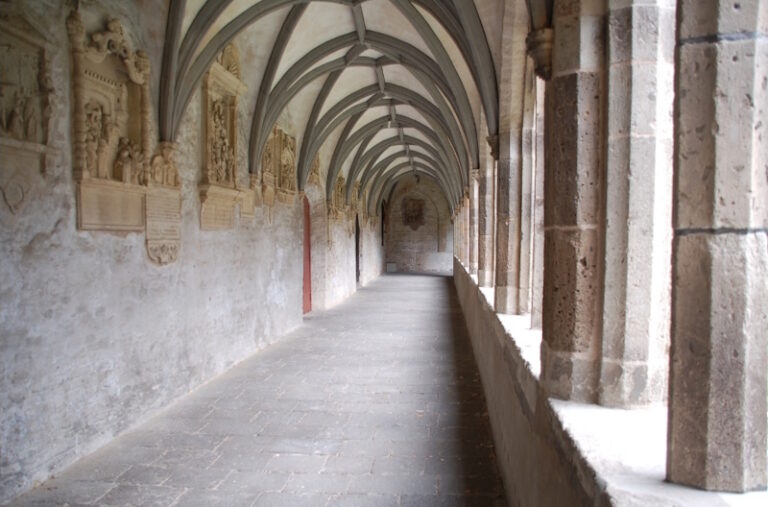
I often made a weekend retreat at Maredret when I lived in Belgium. The community of moniales, women monks, in full habit, sang the complete Liturgy of the Hours in the Benedictine tradition and lived very simple lives.
So how did this jaw-droppingly radical version of Isaiah 55:6-9 end up in their upstairs Eucharistic meditation chapel? Darned if I know. But the healing and comforting image of God, the transcendent, as Wisdom, the immanent, has never left me. It was a gift of grace.
© Susan K. Roll
*Ultramontanism developed as a conservative reaction to the violent secularization of France in the French Revolution, and as a romantic desire to adhere to a stable religious reference point outside the national borders and thus safe from government interference. Its Latin roots mean, to look “over the mountains,” in other words, beyond the Alps, southward – to Rome.
**Edited from the Reflection of September 20, 2020

Susan Roll retired from the Faculty of Theology at Saint Paul University, Ottawa, in 2018, where she served as Director of the Sophia Research Centre. Her research and publications are centred in the fields of liturgy, sacraments, and feminist theology. She holds a Ph.D. from the Catholic University of Leuven (Louvain), Belgium, and has been involved with international academic societies in liturgy and theology, as well as university chaplaincy, Indigenous ministry and church reform projects.