A few months ago, I was at my favourite bookstore hoping to spend a gift card. On a shelf the cover of a book with the title The Soul of an Octopus caught my eye. Curious, I picked it up and read the back cover. Within seconds I knew it was something I had to read.
I know nothing about octopuses and am actually frightened of them. In fact, many years ago while snorkeling in Greece, I came across one draped over an underwater ledge and I swam as fast as my flippers could flip to the nearest shore, smashing my head into a moored fishing boat in the process.
Despite my misgivings, I found myself immersed in the world of cephalopods, the class of mollusks that include clams, oysters and snails. Unlike their other kin, octopuses have no skeletons; they lost them somewhere along their evolutionary path. Today as many as 300 species of deep sea and reef octopuses exist with the largest, the Giant Pacific, weighing in at over 80 kilograms.
Author and Naturalist Sy Montgomery first entered the strange world of octopuses when she volunteered at the New England Aquarium and stuck her arm into an octopus tank. The tentative, gentle touching and tasting of that first tentacle along her arm had Montgomery hooked. She came back day after day to learn more and in the process fell in love with not one but three over the years.
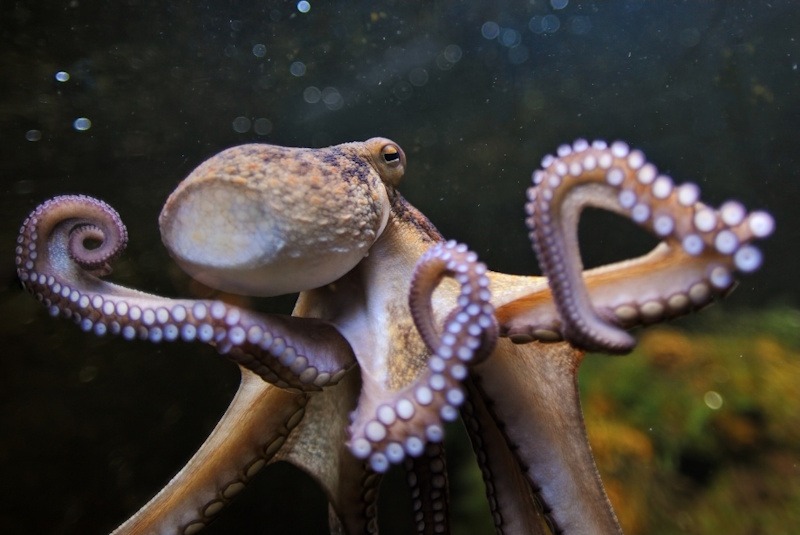
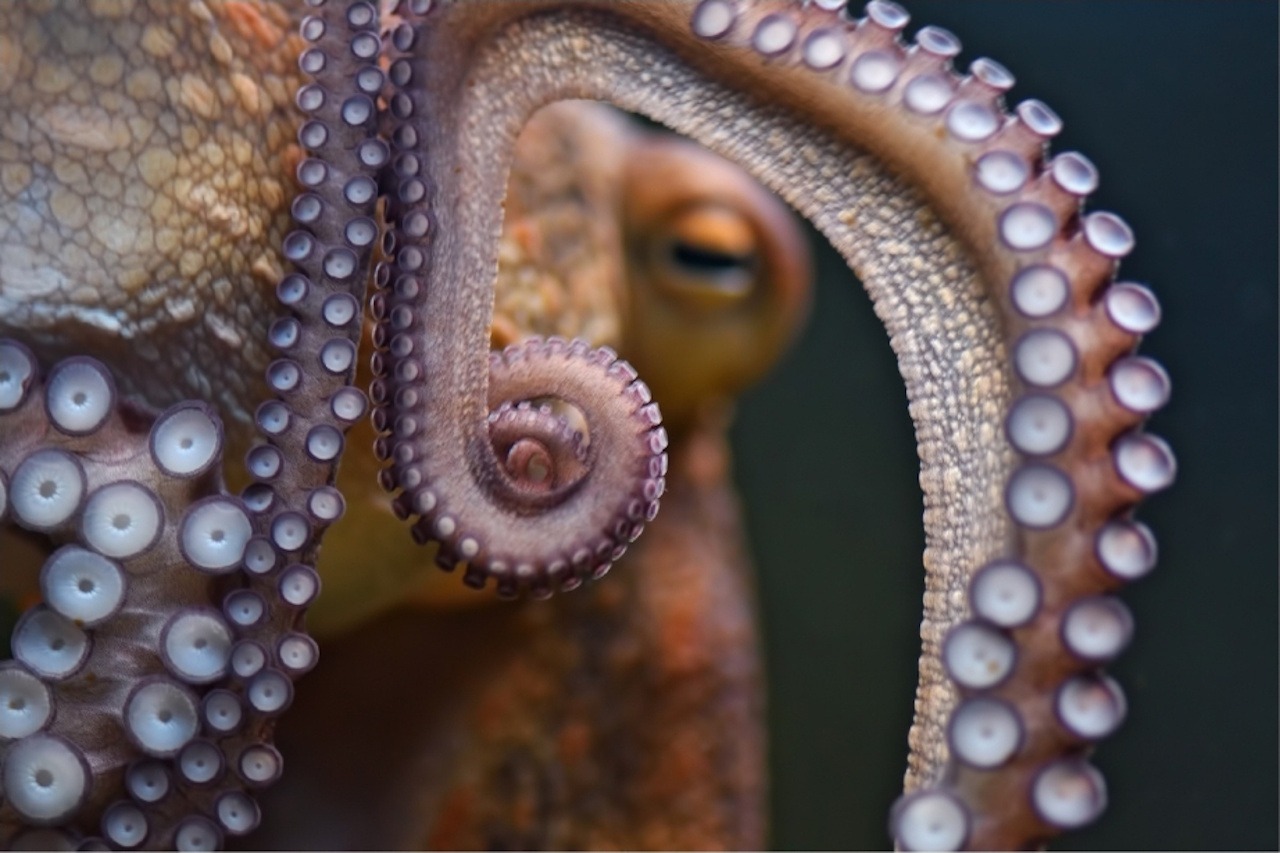
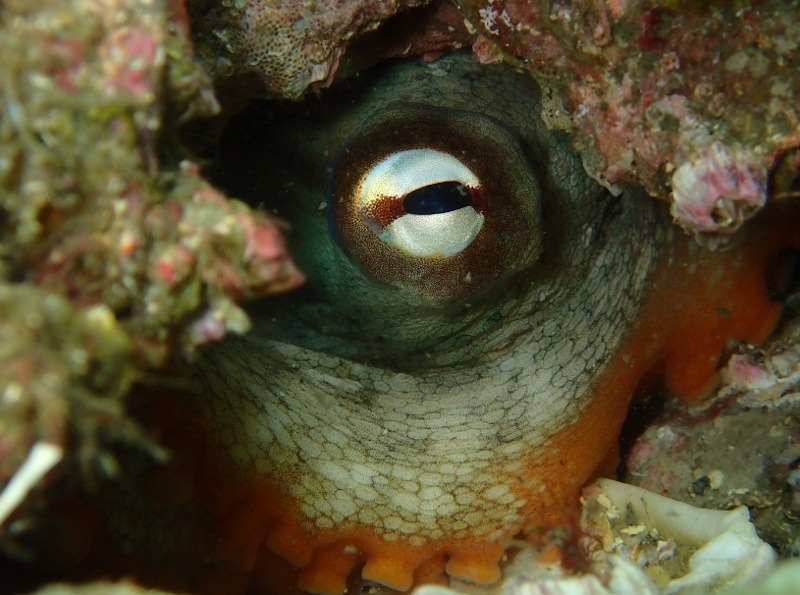
Octopuses live outside the body-brain divide. One could say their entire body is a brain. Each of the eight arms is made up of thousands of neurons and each arm can work independently. If an arm is severed the octopus can grow another and the severed arm can continue to move and grasp for a period of time. Octopuses have two eyes, a mouth with a beak, venom like a snake, ink, like a fountain pen and a tongue covered in teeth. The thousands of suckers on their arms are equipped with sensors that feel, taste and smell.
Although they can weigh as much as a man and can have arms ten feet long, they can also pour their bodies through an opening the size of an orange. An octopus has three hearts, can change colour and shape in milli-seconds, manipulate objects and solve puzzles. A female gives birth to tens of thousands of eggs the size of a grain of rice and will guard them to the point of her own starvation. Octopuses appear to not only recognize people but show signs of affection. Some like to be petted and stroked. Their life span is only three to five years.
During her time at the aquarium as well as her own ocean diving excursions, Montgomery saw the unique, adaptive behaviours of these seemingly alien creatures. She also collected stories from other scientists. Octopuses were known to escape their tanks on a regular basis. One such octopus ate all the fish in another tank before the caretakers figured out the real culprit and closed off the tank top. Another was caught slipping down the stairs in the early morning.
Octopus will squirt water at people they don’t like or, as a joke, at those it does. They can open boxes, play tennis with a plastic ball, learn to manipulate a lever to release food or push unwanted food down a drain while waiting for something tastier. One octopus drained its tank when, out of curiousity or boredom, it opened a valve. Another hated the light being left on near its tank so yanked it down one night. The light was kept off thereafter.
An amazing documentary I saw a few years ago called My Octopus Teacher showed an octopus using a shell to hide in when a predator was nearby. Montgomery and others have observed this numerous times in the wild.
Octopuses are intelligent but it is an intelligence we do not really know how to measure. We are far from knowing exactly what makes them do what they do. But that doesn’t mean I have given up learning about them. Fate has dropped another book into my lap. It is called Other Minds: The Octopus, the Sea and The Deep Origins of Consciousness by Peter Godfrey Smith. Needless to say, I’m immersed once again.
Further Reading
The Soul of an Octopus — Sy Montgomery
A Surprising Exploration into the Wonder of Consciousness
Atria Paperback, Simon & Schuster, 2015
Other Minds — Peter Godfrey-Smith
The Octopus, the Sea, and the Deep Origins of Consciousness
Farrar, Straus and Giroux, 2016

Bonnie Dickie lives in Winnipeg, the Elm capital of Canada. In a previous life she worked for CBC in Yellowknife, NWT before moving South to freelance as a documentary filmmaker. Her work has taken her across the Arctic as well as China, Africa and Spain. Today she is semi-retired and aside from her dog walking exploits is focused on learning to play the ukulele-a talent she has yet to fully grasp.
Thanks Bonnie for this fascinating read made more maningful as we recently watched the Netflix film Remarkably Bright Creatures with its wisdom figue of Marcellus, the Octopus. I am looking forward to reading the Book on which the film was based but after reading your article I think the author Shelby Van Pelt shares your knowlege of the Octopus and its amazing abilities. Mary
Delightful! I like the mystery of these creatures, and yet another reminder to me that I am NOT at the top of the heap! So much we do not know, and so glad to have the opportunity to learn….Thanks, Bonnie!
Thanks so much for book recommendations, Bonnie; I am a big fan of the octopus too. I’ve dreamed of having a small one as a pet, but I don’t think I could handle the fact that they don’t live very long. They are definitely an amazing creature though, and I really appreciate your article!