
As I was packing to leave Belgium in 1995, after ten years at the Faculty of Theology in Leuven/Louvain, a young undergraduate stopped me in the hallway and said that she was happy to have known me. She said that for her I was a model of how a woman today could be “een gelovige vrouw,” meaning, a believing woman, a woman of faith.
Her words were a lovely, sincere gift, and I knew they were coming from a place of at least occasional doubt. And yet, I have pondered since then what it means to be a believing woman. Why do I have this nagging suspicion that a “believing woman” might be naïve, easily manipulated, her work exploited, or simply too compliant with dominant ideologies that do not work in her favour?
And here we come up against the prominent themes in the Gospel for today, about belief, doubt, a demand for irrefutable proof, and maybe something deeper.
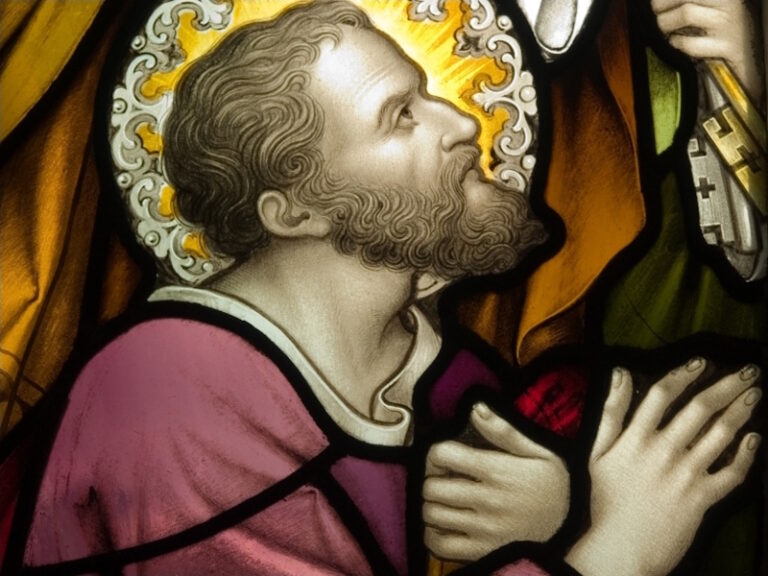
We know the story very well – it comes up every year following Easter Sunday.
We know that “doubting Thomas” missed the first appearance of the risen Christ in a locked room, refused to accept the witnesses’ account of his presence, and set demands that would justify his acceptance of their really not-at-all-credible story.
So, next week, same place, Thomas is there. Christ appears among them, and apparently without touching him Thomas launches into a declaration of faith that goes farther than that of his colleagues. He calls Christ his Lord and God.
Can we call this “doubt shaming?” Who among us has never, ever, doubted?
Maybe we can make something more of this story by taking a closer look at the word for belief. When we use the word “believe” in English it can cover a considerable range: from
“I believe that the sun will rise in the East tomorrow,” (not much room for doubt there), to “I believe that this person’s motives are suspect,” (theoretically possible but needs supporting evidence), to something like “I believe that thus-and-such a country is harbouring weapons of mass destruction,” (you might remember how that turned out.)
What these examples have in common is that they’re operating mostly on a brain level. We know we have to think it through carefully, consulting prior experience, others’ opinions, even instinct. Often we end up overthinking. I know I do.

René Such Schreiner writes in Working Preacher,
“The Greek root behind the English ‘believe’ is pist. While overwhelmingly rendered as faith (for the noun) or believe (for the verb) in English [New Testament] translations, its lexical range fully includes the concept of ‘trust.’ John employs the verb rather than the noun… The English verb ‘believe’ has a predominantly cognitive emphasis – our ‘brain’ either assents or not. Trust, on the other hand, is more relational and exists on a spectrum – often encompassing the feelings [sic] that influence our thoughts and actions. Hence, we often associate believing with our ‘heads’ and ‘trusting’ with our hearts.”
What happens when we shift our translated text? Jesus says to Thomas, “Do not distrust, but trust.”When Thomas bursts out with “My Lord and my God!” Jesus responds,
“Do you trust because you have seen me? Blessed are those who have not seen and yet trust.”
This is a tough one, because trust makes us potentially vulnerable if it doesn’t work out. Did you ever participate in a “trust walk” in a youth activity or a retreat, or fallen backwards into the arms of people who, you hoped to God, hadn’t moved? Have you ever been asked to trust a person who had already betrayed your trust? Betrayed your trust multiple times?
Trust involves risk, even danger. But it was the key to moving forward in mission for the early Christian community, paralyzed by fear of the Roman authorities on one hand and reviled by their own religious authorities on the other. Taking action, particularly one that demands courage and daring, requires the shared energy of a community able to set its (probably justified) fear aside. They were carrying the message of a life that does not die, a message that to logical minds is simply un-believable. A message that calls to the heart.
© Susan K. Roll
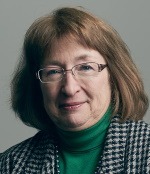
Susan Roll retired from the Faculty of Theology at Saint Paul University, Ottawa, in 2018, where she served as Director of the Sophia Research Centre. Her research and publications are centred in the fields of liturgy, sacraments, and feminist theology. She holds a Ph.D. from the Catholic University of Leuven (Louvain), Belgium, and has been involved with international academic societies in liturgy and theology, as well as university chaplaincy, Indigenous ministry and church reform projects.